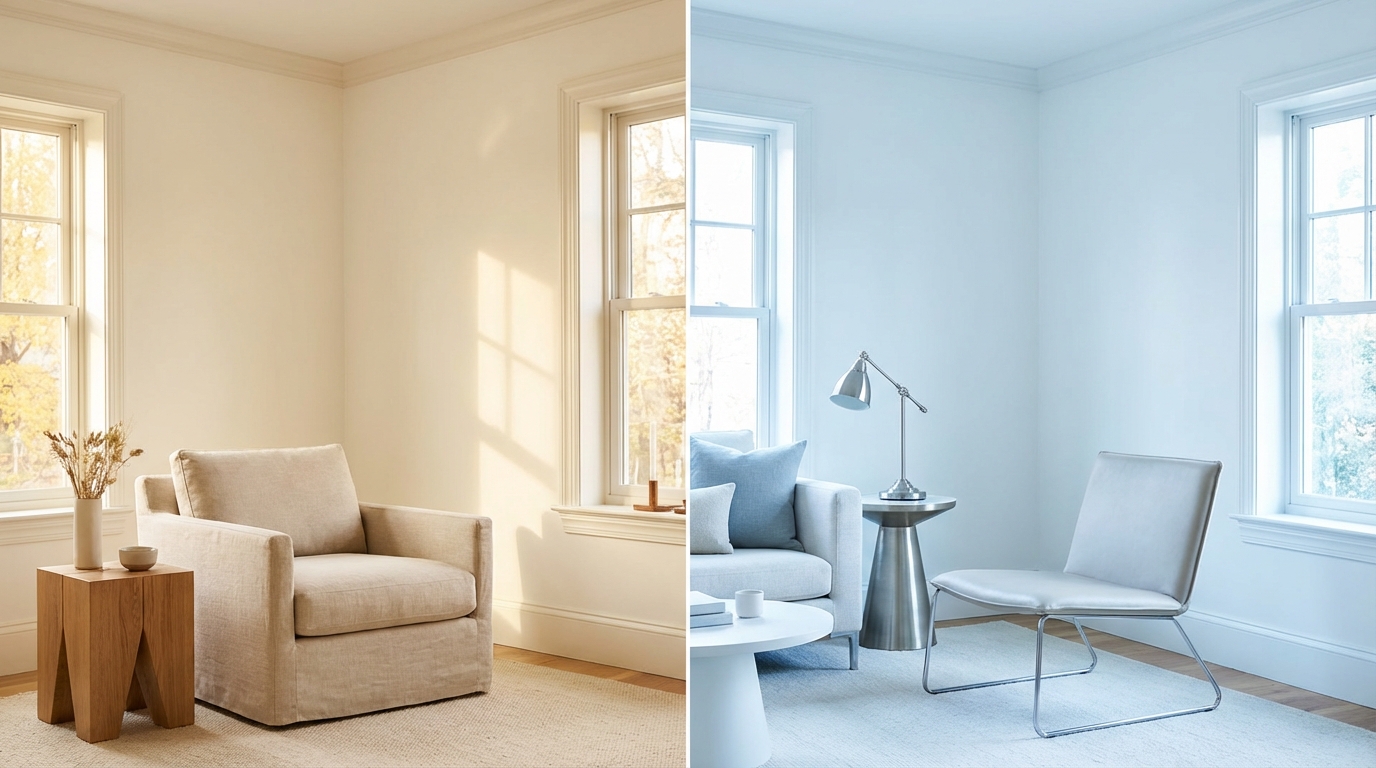
The difference between a warm white and a cool white isn't subtle. On four walls, it's the difference between "cozy and inviting" and "is this a hospital?"
I know—they both look basically the same on a chip. Two slightly-off-whites. Who cares. But slap either one on four walls and a ceiling, and the room transforms in very different directions. Warm whites glow. Cool whites recede. And the wrong one for your room makes everything feel... off. Not bad exactly, but like something you can't quite put your finger on.
I found this out the expensive way. Painted my first apartment's living room in a "beautiful white" from the store. Didn't check the undertone. Turns out it was a blue-cool white, and in my north-facing living room with one small window, it looked like the inside of a refrigerator. Cold. Sterile. My tan leather couch looked orange against it. Repainted within three months.
That was a $300 lesson. Let me save you the tuition.
Warm White vs. Cool White: The Quick Distinction
Warm whites have yellow, pink, or golden undertones. They feel like natural sunlight, candlelight, or cream. They make rooms feel cozy, inviting, organic.
Cool whites have blue, gray, or green undertones. They feel like fresh snow, bright daylight, or clean sheets. They make rooms feel crisp, modern, airy.
Neither is "better." But one is almost always better for your specific room.
How to Actually See the Difference
On a paint chip under store fluorescent lights, most whites look the same. Here's how to actually tell them apart:
The white card test: Hold the paint chip next to a pure white piece of paper (printer paper works). Suddenly the undertone jumps out. Yellow tint? Warm. Blue or gray tint? Cool. Pink tint? Warm-leaning. Green tint? Cool-leaning.
The comparison test: Hold two whites next to each other. When you see Simply White (warm) next to Chantilly Lace (cool), the difference is obvious. In isolation, they both just look "white."
The Most Popular Warm Whites
These are the warm whites that designers keep coming back to. Pantone validated the warm white direction by naming Cloud Dancer (a warm white) their 2026 Color of the Year.
Simply White OC-117 (Benjamin Moore)
LRV: 91.7 | Undertone: Very slight yellow-warm
The single most popular warm white in interior design. It's warm enough to feel alive but clean enough to not read as "yellow." If you want a warm white and have no idea where to start, this is the one.
Works in: Literally any room. This is a universal warm white.
White Dove OC-17 (Benjamin Moore)
LRV: 85.4 | Undertone: Soft, creamy yellow
A step warmer and deeper than Simply White. This is the warm white that feels like buttered bread. Designers use it constantly because it has just enough warmth to feel intentional without feeling colored.
Works best in: Living rooms, bedrooms, whole-house applications.
Alabaster SW 7008 (Sherwin-Williams)
LRV: 82 | Undertone: Warm, very slightly yellow
The Sherwin-Williams equivalent to White Dove. Creamy, soft, and almost impossible to screw up. The go-to warm white for anyone using SW paint.
Works best in: Open-concept homes, kitchens, bathrooms.
Swiss Coffee OC-45 (Benjamin Moore)
LRV: 81.7 | Undertone: Yellow-warm, slightly stronger
This one's warmer than White Dove—noticeably so. It's the warm white that actually reads as "cream" in certain light. Looks great in sunny, south-facing rooms. In north-facing rooms it can go slightly dirty-yellow, though—be careful.
Works best in: South or west-facing rooms with lots of natural light.
Cloud Dancer 11-4201 (Pantone)
LRV: ~89 | Undertone: Soft warm
The 2026 Color of the Year. Not as commonly available at paint stores as Benjamin Moore or Sherwin-Williams options, but the message it sends is clear: the industry is moving to warm whites.
The Most Popular Cool Whites
Cool whites aren't dead—they have specific use cases where they outperform warm whites.
Chantilly Lace OC-65 (Benjamin Moore)
LRV: 92.2 | Undertone: Nearly true white, very slight cool
The closest you can get to "no undertone" white. Designers call it a "true" white, though even this one leans ever so slightly cool. It's the white you use when you genuinely want neutral white—not warm, not cool, just white.
Works best in: Trim (pairs with any wall color), contemporary spaces, art galleries.
Extra White SW 7006 (Sherwin-Williams)
LRV: 86 | Undertone: Clean, bright, slightly cool
Sharp and crisp. This is the white for modern, minimalist interiors where you want brightness without warmth.
Works best in: Modern spaces, bright south-facing rooms where warmth isn't needed.
Decorator's White OC-149 (Benjamin Moore)
LRV: 90.8 | Undertone: Slight blue-gray
A distinctly cool white that reads as ultra-clean and modern. Looks great in the right context, but unforgiving in the wrong one.
Works best in: Modern/contemporary interiors, south-facing rooms, bathrooms going for a "bright and fresh" look.
How to Choose Based on Your Room
Your Room Faces North
Go warm. Always warm. North-facing rooms get cool, bluish light all day. A cool white in a north-facing room amplifies the coldness. It literally feels colder—not just emotionally, but people report perceiving rooms as physically cooler when they're painted in cool tones.
Best picks: White Dove, Alabaster, Simply White. These counteract the cool light and make the room feel naturally bright rather than artificially cold.
Your Room Faces South
You can go either way. South-facing rooms are bathed in warm light. A warm white will feel very warm (almost golden at certain times). A cool white will feel bright and balanced. It's personal preference.
Best picks: Simply White if you want warm. Chantilly Lace or Decorator's White if you want crisp.
Your Room Faces East
Morning light is warm, afternoon light is cool. Your room changes mood throughout the day.
Best pick: Simply White—it handles both warm and cool light well without going too far in either direction.
Your Room Faces West
Afternoon and evening light is warm and golden. Cool whites will look normal during the day and slightly warm in the evening. Warm whites will glow golden in the evening.
Best pick: Depends on your preference. If you love that golden-hour glow, go warm (White Dove). If you want a more consistent look, go neutral-to-cool (Chantilly Lace).
Warm White vs. Cool White: The Head-to-Head
| Factor | Warm White | Cool White |
|---|---|---|
| Feeling | Cozy, inviting, organic | Crisp, modern, clean |
| Works with warm wood floors | YES — harmonizes | Can create contrast (good or jarring) |
| Works with cool metals (chrome) | Slight clash possible | YES — feels cohesive |
| North-facing rooms | BEST CHOICE | Avoid (feels cold) |
| South-facing rooms | Can feel very warm | Works great |
| With colorful art | Great backdrop | Can wash out some colors |
| 2026 trend alignment | Strongly trending | Moving out of fashion |
| Resale appeal | Currently favored | Was favored 2015-2022 |
The Biggest Warm White Mistakes
Picking warm white for a room with cool-toned everything. If you have gray flooring, chrome fixtures, and blue-gray furniture, a warm white wall is going to clash. The warmth highlights how cool everything else is. Match your white to your room's temperature.
Going TOO warm in a small room. Very warm whites (like Swiss Coffee) in a tiny room with limited light can read as dirty or yellowed. If your room is small and dark, a cleaner warm white like Simply White or Alabaster is safer than a deeply warm one.
Using warm white trim with cool white walls. Or vice versa. Mixing temperatures on adjacent surfaces makes both look wrong. Warm walls + warm trim. Cool walls + cool trim. Or, the classic: any wall color + Chantilly Lace trim (since it's nearly true white, it works with both).
The Biggest Cool White Mistakes
Using cool white in a dark room. Cool whites need light to look bright. In a dim room, they just look gray. It's the most common complaint I hear: "I painted it white but it looks gray." Almost always a cool white in a north-facing or poorly lit room.
Cool white everything. An all-cool-white room can feel clinical—like a lab or a gallery. If you go cool white on walls, warm it up with wood furniture, warm textiles, and warm-toned lighting. The room needs something warm.
Assuming "white is white." The most costly assumption. The difference between these whites is real and visible. If you grab the first "white" you see at the store without checking undertone and room orientation, you're rolling the dice.
My Recommendation for 2026
Go warm. Here's why:
The whole industry has shifted warm. Pantone's COTY is a warm white. Paint brands are all pushing warm neutrals. Cool-toned interiors peaked around 2018 and have been declining since.
More practically: warm whites are more forgiving. They look good in more lighting conditions, they pair with more furniture styles, and they create a more universally "pleasant" feeling than cool whites.
If I had to recommend one white for someone who doesn't want to overthink it: Simply White OC-117. It works in 90% of situations. For Sherwin-Williams users: Alabaster SW 7008. Same deal.
Test It. Seriously.
White paint is the easiest thing to get wrong because the differences look tiny on a chip and huge on a wall. Buy two sample pots—one warm, one cool—and paint them side by side on the same wall.
Or faster: open Muro, try both on your actual wall photo, and see the difference in 30 seconds. The warm/cool distinction becomes immediately obvious when you see it on YOUR wall, in YOUR lighting.
Don't just pick "white" and hope for the best. Pick the RIGHT white.
The Bottom Line
Warm whites feel like home. Cool whites feel like a design magazine. Neither is wrong, but one is right for your specific room.
Check your room's orientation, look at your existing furniture and flooring, and match accordingly. In 2026, the safe bet is warm. But if you have a bright, modern, south-facing space with cool-toned finishes, a clean cool white can still look great.
Just please, don't grab the first white paint you see without checking the undertone. You'll save yourself a repaint.