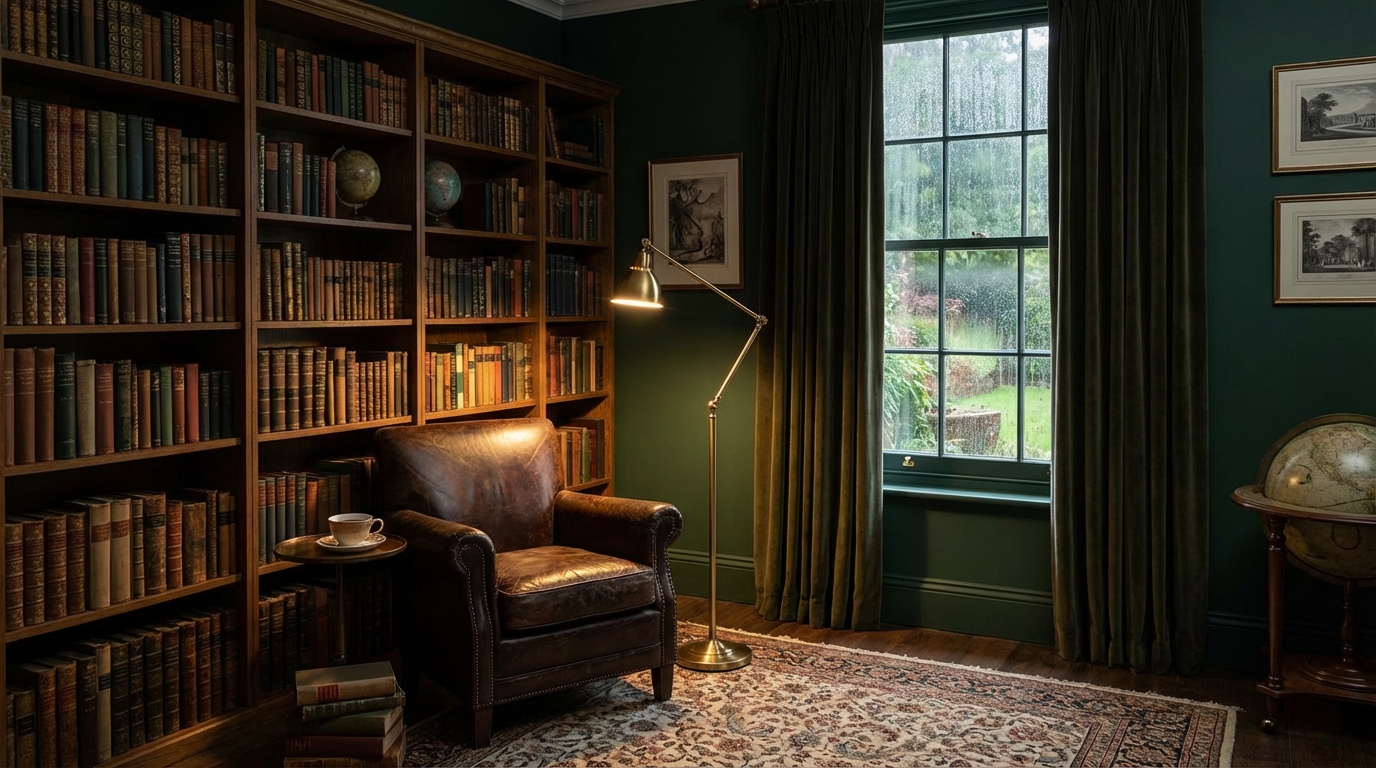
Dark academia paint colors: forest green, oxblood red, charcoal brown, deep navy, and warm tobacco. These are the colors that turn a regular room into something that looks like a 19th century Oxford library—leather armchairs, wall-to-wall bookshelves, warm lamplight flickering off dark walls.
If you've spent any time on Pinterest or TikTok in the last two years, you've seen this aesthetic everywhere. Dark wood, old books, moody lighting, and wall colors that would make a Victorian professor feel right at home. And honestly? It translates to real interiors better than most trends do.
I turned my home office into a dark academia space about a year ago. Forest green walls, dark walnut bookshelves, a brass desk lamp, leather desk chair. People walk in and their whole posture changes—they slow down, speak quieter, like they've entered a different world. It's one of those spaces where the color does most of the work.
But here's the thing about dark colors—they're a serious commitment. You can't just pick "the darkest green" and slap it on four walls. The undertones, the lighting, the room size, the furniture—everything matters more when you're working with low-LRV colors. Get it right and you have a masterpiece. Get it wrong and you have a cave.
What Makes a Color "Dark Academia"
Dark academia isn't just "dark colors." It's a specific palette with warmth and depth. The colors feel old, layered, organic—like they've been there for a hundred years. Think aged leather, worn wood, vintage paper, autumn leaves.
The palette breaks down into five core colors:
1. Forest Green — The Foundation
This is the default dark academia color. Deep, slightly blue-green. The color of old library walls, hunting lodges, and every Ivy League common room you've seen in movies.
Best colors:
- Hunt Club SW 6468 (Sherwin-Williams) — LRV: 4. The classic. Deep, saturated, true forest green. My personal pick for my office.
- Backwoods 469 (Benjamin Moore) — LRV: 4. Slightly more contemporary than Hunt Club. A touch more blue.
- Essex Green HC-188 (Benjamin Moore) — LRV: 3. Even deeper and more black-green. For maximum drama.
2. Oxblood / Burgundy — The Drama
Oxblood is the color that makes dark academia feel warm rather than cold. It's that deep red-brown you see on old book covers and vintage leather.
Best colors:
- Carriage Red CW-250 (Benjamin Moore) — LRV: 7. A refined, brownish red. Not fire-engine red—nothing should be bright in dark academia.
- Rookwood Red SW 2802 (Sherwin-Williams) — LRV: 5. Deeper and more muted. Feels genuinely old.
- Cascabel Chile 9003 (Sherwin-Williams) — LRV: 8. Warmer and slightly more approachable than Rookwood.
3. Charcoal Brown — The Sophisticate
Not gray. Not pure brown. Something in between that feels like the inside of a cigar box or the color of aged oak. Benjamin Moore's 2026 Color of the Year, Silhouette, lives in this territory.
Best colors:
- Silhouette AF-655 (Benjamin Moore) — LRV: ~8. Shifts between charcoal, brown, and plum. Genuinely complex.
- Black Fox SW 7020 (Sherwin-Williams) — LRV: 7. A warm dark brown with gray undertones.
- Urbane Bronze SW 7048 (Sherwin-Williams) — LRV: 8. Was a 2021 COTY. Still works beautifully.
4. Deep Navy — The Classic
Navy in dark academia is deeper and warmer than standard navy. It shouldn't feel nautical or preppy. Think midnight sky, not sailor stripes.
Best colors:
- Hale Navy HC-154 (Benjamin Moore) — LRV: 6. The designer favorite. Rich without being black.
- Naval SW 6244 (Sherwin-Williams) — LRV: 4. Deeper and more dramatic than Hale Navy.
- Gentleman's Gray 2062-20 (Benjamin Moore) — LRV: 5. Navy with a sophisticated gray cast.
5. Tobacco / Warm Brown — The Grounding Element
Warm, amber-toned brown. The color of aged whiskey, old wood, tobacco leaves. This is what keeps dark academia from feeling cold.
Best colors:
- Tudor Brown HC-67 (Benjamin Moore) — LRV: 5. Deep and warm. Has been around forever for a reason.
- Van Buren Brown HC-70 (Benjamin Moore) — LRV: 7. Slightly lighter and more amber.
- Tiki Hut SW 7509 (Sherwin-Williams) — LRV: 16. More approachable. Good for larger spaces.
Room-by-Room Guide
The Home Office / Study (The Natural Choice)
This is where dark academia makes the most sense. You're creating a focused, contemplative space. The dark colors reduce visual noise and help you concentrate.
My recommendation: Forest green walls, warm brass desk lamp, dark wood furniture. Use eggshell or matte finish—nothing should be shiny in a dark academia space.
The room doesn't need to be big. In fact, smaller rooms work better. A 10x12 office painted in Hunt Club with warm lighting feels like a private library. A 20x20 great room painted the same color might feel like a void.
The Bedroom (The Cocoon)
Dark academia bedrooms are trending for a reason—they're incredibly cozy. Imagine waking up surrounded by warm, dark walls with morning light filtering through.
My recommendation: Charcoal brown or deep navy. These are slightly softer than forest green for a sleeping space. Pair with cream or warm white bedding—the contrast is key.
Warning: Make sure you actually like the color at all hours. Dark bedrooms can feel oppressive if you're someone who needs brightness to wake up. Try the color first and live with it mentally for a few days.
The Dining Room (The Showstopper)
Dinner parties in a dark academia dining room are an experience. Candlelight bouncing off deep-colored walls creates an intimacy that no amount of interior design tricks can replicate.
My recommendation: Oxblood or tobacco brown. Both glow under warm light in a way that's almost magical. Add a few candles and you've got an atmosphere that people will comment on.
The Powder Room (The Starter Space)
Not ready to commit to a whole room? Start here. A small powder room painted in a deep green or oxblood is a low-risk, high-impact move. Guests will love it. And if you decide it's too dark, it's a three-hour repaint.
The Lighting Situation (This Is Non-Negotiable)
I cannot stress this enough: dark academia colors REQUIRE good lighting. These are all low-LRV colors (3-8 range). They absorb most of the light that hits them. Without intentional lighting, you don't get "moody library." You get "basement."
What works:
- Warm LED bulbs (2700K) — This is the color temperature of candlelight. Anything cooler turns dark colors gray and lifeless.
- Table lamps and floor lamps — Multiple light sources at different heights. Not a single overhead fixture.
- Brass or copper fixtures — The warm metal tones look great against dark walls.
- LED strips above bookshelves — This is my secret weapon. Warm LED strips tucked behind a shelf create a soft glow that makes the wall color come alive.
- Candles — Obviously. Dark academia without candles is like a library without books.
What doesn't work:
- Overhead fluorescent or cool-white LEDs
- A single overhead dome light (creates harsh shadows that make dark walls feel oppressive)
- No artificial lighting plan at all (hoping natural light will be enough—it won't, especially in winter)
The Furniture & Decor
The paint is only half of it. Dark academia comes together with the right furnishings:
Essential:
- Dark wood furniture (walnut, mahogany, dark oak)
- Leather seating (aged or distressed)
- Brass hardware and fixtures
- Books. Lots of actual books.
Nice to have:
- Vintage or antique frames
- Woven textiles (tweed, wool, velvet)
- A substantial rug with warm tones
- Globe, vintage maps, or botanical prints
Avoid:
- Chrome or stainless steel (too modern)
- Plastic anything
- Bright accent colors (no throw pillows in turquoise, please)
- Ultra-modern minimalist furniture (the styles clash)
The Sheen Question
Matte. Always matte for dark academia walls.
Here's why: dark colors in a satin or semi-gloss finish reflect light unevenly. You get hot spots and weird reflections that break the immersive feel. Matte absorbs light evenly and creates that deep, velvety look that dark academia is all about.
The downside of matte: it's less wipeable and shows scuffs more easily. For a home office or dining room that gets gentle use, that's fine. For a hallway or kitchen, you might need to compromise with an eggshell.
Common Mistakes
Going too dark too fast. If you've never lived with dark walls, jumping straight to LRV 3 can be a shock. Consider starting with something in the LRV 8-15 range—still moody, but less intense.
Ignoring the ceiling. A white ceiling against dark walls creates a jarring contrast that kills the mood. Either paint the ceiling the same dark color (full color drenching) or use a warm off-white that's not stark white. Something like White Dove OC-17 that eases the transition.
Skipping the trim conversation. White trim can work with dark academia—it creates a more structured, formal feel. But consider painting trim in a warm cream or even the wall color itself for a more immersive look.
Forgetting about adjacent spaces. If your dark academia study opens directly into a bright white kitchen, the contrast can be jarring. Plan the transition between spaces.
Will This Trend Last?
Dark academia as a TikTok trend? Probably has another year or two. Dark, deep paint colors in well-designed rooms? That's been working since the actual Victorian era. Libraries have been painted hunter green and oxblood for centuries. Social media just gave a catchy name to something people have always done.
If you pick colors based on what genuinely looks good in your space (rather than chasing the hashtag), the result will be timeless.
The Bottom Line
Dark academia paint isn't about being trendy—it's about creating a space that feels warm and lived-in. The kind of room that makes you want to sit down with a book and a drink.
Pick one room. Start with forest green or charcoal brown—they're the most versatile options. Get your lighting right. Add warm wood and brass. And preview the color on your walls before committing—dark colors are a bigger commitment than light ones, and they're more expensive to undo.
Use Muro to see how these deep colors actually look in your specific room. Because LRV 4 on a chip and LRV 4 on four walls are two very different things.