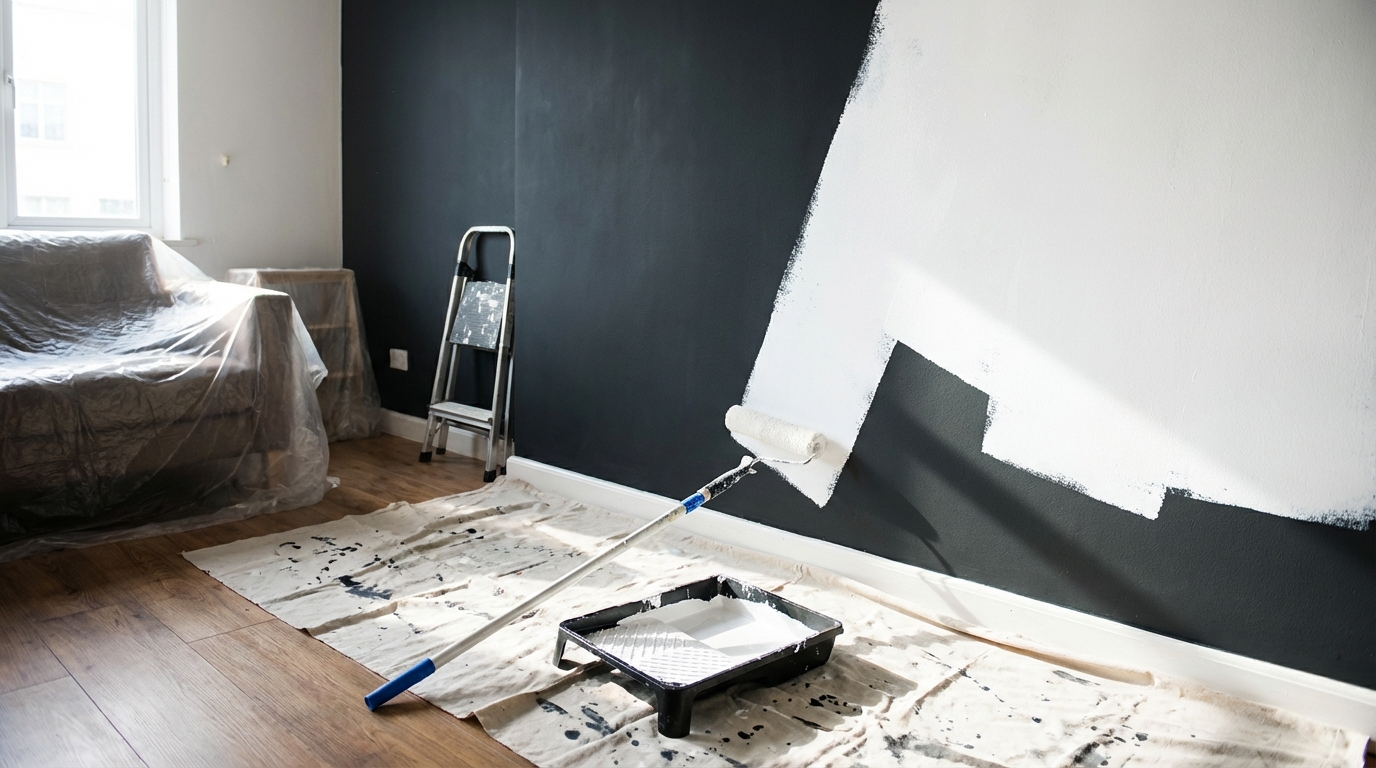
Three steps: gray-tinted primer, two coats of new color, patience. That's the entire formula. Trying to skip the primer and go directly from Hale Navy by Benjamin Moore (HC-154) to Simply White by Benjamin Moore (OC-117)? That's how you end up with five coats, a sore arm, and purple shadows that won't quit.
I tried the "just use more coats" approach once. Dark red accent wall to light gray. Six coats of premium paint later, I could still see pink in certain light. The primer would have cost me $30 and saved me $150 in extra paint plus a weekend of frustration.
Why dark-to-light is so hard
Understanding the problem helps you solve it properly.
Pigment bleed-through
Dark paints have concentrated pigments. Red, blue, and green pigments are especially aggressive. Even after your new paint dries, these pigments can migrate through the paint film and show on the surface.
This is why you might paint over a dark wall, think it looks perfect, and then see weird shadows appear days later. The pigments are literally moving through your new paint.
Undertone contamination
Every paint color has an undertone. Dark blues have purple or green undertones. Dark reds have orange or pink undertones. When you paint light colors over them, those undertones mix with your new color.
Trying to paint white over dark blue? You'll get a grayish, purplish cast. White over dark red? Peachy pink. No amount of additional coats fixes this because the undertone keeps bleeding through.
The thin-film problem
Paint is thinner than you think. Even multiple coats create a film that's only a few millimeters thick. Light passes through this film, bounces off the dark color underneath, and comes back altered.
This is why even when you achieve full "coverage," the color looks different than expected. You're seeing your new color plus the ghost of the old color.
The 3-step method
Step 1: Gray-tinted primer
This is the part most people get wrong. Don't use white primer. Use primer tinted to a medium gray.
Why gray works better than white:
White primer over dark colors still requires the primer to completely block the dark pigments. That's asking a lot. Gray primer meets the dark color halfway. It neutralizes the undertones instead of trying to overpower them.
How to get it:
Ask your paint store to tint your primer to about 50% of the depth of your final color. If you're going to a light gray, ask for a medium gray primer. If you're going to white, ask for a light-medium gray.
Most stores will do this for free or a small fee. Brands like Zinsser, KILZ, and Behr all make tintable primers.
Application:
One coat is usually enough. Two if you're covering something really dark or vibrant like fire-engine red or deep purple. Let it dry completely, at least 4 hours.
Step 2: Two coats of your final color
With proper primer underneath, you should achieve full coverage in two coats of your topcoat. Not one. Two.
First coat: Apply evenly, don't stress about full coverage. You'll likely see some of the primer showing through, and that's fine.
Dry time: Wait the full recoat time recommended on the can. Usually 4 hours for latex paint. Don't rush this.
Second coat: This one finishes the job. After the second coat dries, you should have complete, even coverage with your new color looking exactly like the swatch.
If you still see shadows after two topcoats over proper primer, something went wrong. Either the primer wasn't blocking enough (needed two coats) or you're not applying enough paint per coat.
Step 3: Patience
This is the step everyone skips.
Don't evaluate the color until it's fully dry. Wet paint looks different than dry paint. Dark patches that appear while drying usually disappear.
Wait 24 hours before deciding if you need touch-ups. Sometimes what looks like poor coverage is just uneven drying. Give it a full day.
Wait 3-4 days before moving furniture against the walls. Even though the paint feels dry, it's not fully cured. Dark pigments can transfer if you press things against the wall too soon.
The colors that cause the most trouble
Reds and oranges
The worst offenders. Red pigment is aggressive and loves to bleed through. Painting over a red accent wall? Plan for two coats of primer minimum.
Use: Shellac-based primer (like Zinsser B-I-N) for red. It blocks better than latex primer.
Deep blues and teals
Blue pigments have strong purple undertones that show through lighter colors as a gray or violet cast.
Covering Hale Navy by Benjamin Moore (HC-154) or Sherwin-Williams Naval (SW 6244)? Gray-tinted primer is essential.
Dark greens
Forest greens and emerald colors have yellow undertones that can make your new paint look sickly or warm.
Covering a dark green? Ask for a primer with a slight blue-gray tint to neutralize the yellow.
Black and charcoal
Surprisingly, pure black is often easier than saturated colors. Black doesn't have strong undertones, so it's mainly about opacity, not color correction.
Still use gray primer, but you might get away with one coat.
Common mistakes
Mistake 1: Using white primer
White primer is designed for new drywall and light color changes. It has to do all the heavy lifting against dark pigments, which it wasn't designed for.
Gray primer makes the job easier for everyone, including your topcoat.
Mistake 2: Skipping primer entirely
"The paint says it's paint and primer in one!"
Yes, and that works great for light-to-light color changes. For dark-to-light? Those products don't have the blocking power. You'll spend more money on extra paint than you would have spent on primer.
Mistake 3: Not letting coats dry completely
Rushing between coats traps solvents and moisture, which can cause:
- Bubbling and peeling
- Uneven sheen
- Poor color development
- Pigment bleed-through weeks later
Just wait. Put on a podcast. Do something else.
Mistake 4: Using too little paint per coat
Thin coats dry faster but don't block as well. Each coat should be substantial, fully wetting the roller and applying with moderate pressure.
The goal is complete, even coverage per coat, not speed.
Mistake 5: Evaluating color too soon
Colors look different wet vs. dry, in morning light vs. evening light, near windows vs. in corners.
Give the paint 24-48 hours before you decide it's wrong. Often it's exactly right and you just needed to let it cure.
The cost comparison
Let's say you're covering 400 square feet of dark blue walls.
The "skip primer" approach:
- 2 gallons of premium paint: $120
- Doesn't cover in 2 coats, need more
- 1 more gallon: $60
- Still seeing shadows, need more
- Total: $180+, 4-5 coats, lots of frustration
The proper approach:
- 1 gallon of gray-tinted primer: $35
- 2 gallons of regular (not premium) paint: $80
- Total: $115, 3 coats, done right
The primer isn't an extra cost. It's a savings.
Special situations
Textured walls
Dark paint on textured walls is harder to cover because the texture creates shadows. You may need to use a thicker-nap roller (3/4") to get paint into all the crevices.
Plan for one extra coat of everything: primer and topcoat.
Glossy dark paint
The old paint has a sheen that your new paint won't stick to. Before priming, you need to either:
- Lightly sand the entire surface (220 grit)
- Use a liquid deglosser/sander
- Use a bonding primer instead of standard primer
Don't skip this or your beautiful new paint will peel.
The dark paint is peeling or damaged
If the old paint is failing, you have a bigger problem than color. You need to:
- Scrape off loose paint
- Sand the edges smooth
- Patch any damage
- Prime bare spots with appropriate primer
- Then prime the whole wall with your gray-tinted primer
You changed your mind about light paint
Going back dark after already painting light? That's actually easier. One coat of primer to even things out, two coats of dark color. Dark covers light without the bleeding issues.
Gray primer is the whole secret
Dark-to-light color changes require gray-tinted primer. There's no shortcut that actually works. The primer costs less than the extra paint you'd use trying to skip it, and it saves hours of frustration.
One coat of gray primer. Two coats of your new color. Wait for proper dry times. That's the formula. It works on red, blue, green, black, and everything in between.
And if you're painting over red? Use shellac primer. Trust me on this one.