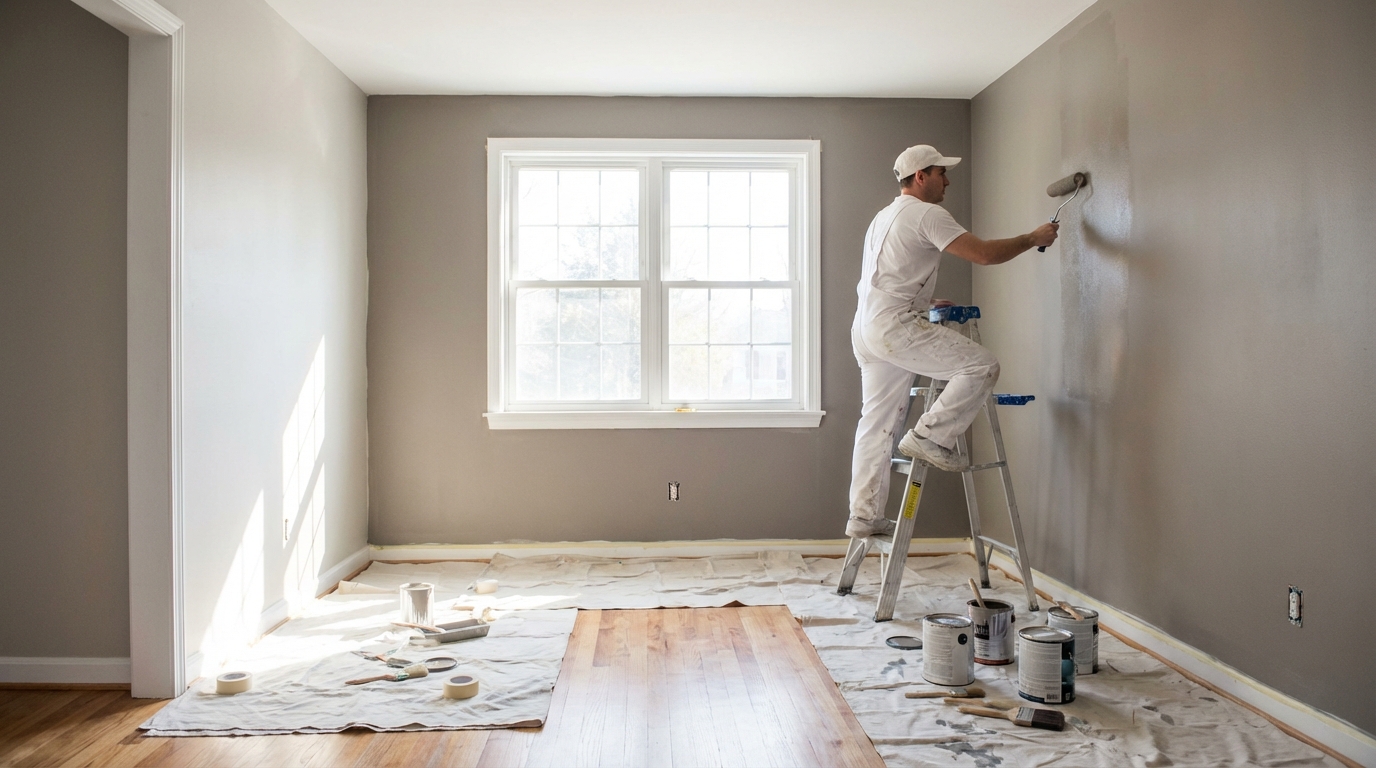
One gallon covers 350-400 square feet. For a typical 12x12 bedroom with 8-foot ceilings, you need about 2 gallons for walls (two coats) or 2.5 gallons including the ceiling.
That's the quick answer. But I've learned that the quick answer leads to either too little paint (running out mid-wall is a special kind of misery) or too much (gallons sitting in my garage for years). Let me show you how to calculate precisely.
Formula
Here's the actual math:
Paint needed = (Wall area × Number of coats) ÷ 350
Here's a real example, a 12x12 bedroom with 8-foot ceilings, one door, and two windows:
- Wall perimeter: 12 + 12 + 12 + 12 = 48 feet
- Wall area: 48 × 8 = 384 square feet
- Subtract openings: door (20 sq ft) + 2 windows (30 sq ft) = 50 sq ft
- Paintable area: 384 - 50 = 334 square feet
- For 2 coats: 334 × 2 = 668 square feet
- Paint needed: 668 ÷ 350 = 1.9 gallons
Round up to 2 gallons. Done.
Step-by-step calculation
Step 1: Measure your walls
For rectangular rooms, there's a shortcut:
- Add all wall lengths together (the perimeter)
- Multiply by ceiling height
- That's your total wall area
For rooms with irregular shapes, measure each wall individually and add them up.
Pro tip: Don't obsess over precise measurements. Being within a foot is fine. Paint coverage varies enough that extra precision doesn't help.
Step 2: Subtract windows and doors
Standard deductions I use:
- Standard door: 20 square feet
- Standard window: 15 square feet
- Large picture window: 25 square feet
- Sliding glass door: 50 square feet
Important: Don't skip this step. I used to think "eh, close enough" and consistently overbought. A room with lots of windows needs significantly less paint.
Step 3: Determine number of coats
Here's where many people miscalculate.
You need two coats if:
- Changing from one color to another (almost always)
- Painting new drywall
- Previously unpainted surfaces
- You want even coverage without streaks
One coat might work if:
- Same color touch-up
- Using premium paint-and-primer-in-one (and going light to light)
- Covering a very light color with another very light color
Three coats required for:
- Dark to very light color changes (or use tinted primer)
- Bright reds, yellows, or oranges (these colors cover terribly)
I assume two coats for everything. The "one coat coverage" marketing claim is technically true but practically useless for most projects.
Step 4: Do the math
Use 350 sq ft/gallon as your baseline. Premium paints sometimes claim 400+ but I've never found that accurate in real conditions.
| Paint Type | Coverage per Gallon |
|---|---|
| Standard interior latex | 350-400 sq ft |
| Premium interior | 350-400 sq ft (marketing lies notwithstanding) |
| Exterior paint | 300-350 sq ft |
| Textured surfaces | 250-300 sq ft |
| Primer | 200-300 sq ft |
Use the lower number. Running out mid-wall means a store trip, potential batch number mismatch, and visible color variation on your wall.
Quick reference table
I use this constantly:
| Room Size | Walls Only (2 coats) | Walls + Ceiling |
|---|---|---|
| Small bathroom (5x8) | 1 gallon | 1.5 gallons |
| Bedroom (10x10) | 1.5 gallons | 2 gallons |
| Living room (12x15) | 2 gallons | 2.5 gallons |
| Master bedroom (14x16) | 2.5 gallons | 3.5 gallons |
| Open concept (20x30) | 4 gallons | 5-6 gallons |
These assume 8-foot ceilings and typical window/door counts. Adjust up for 9-10 foot ceilings.
Ceiling paint calculation
Ceilings are easier—just length times width:
- 12 × 15 room = 180 square feet
- 180 ÷ 350 = 0.51 gallons for one coat
- Double for two coats = 1.02 gallons
Buy a gallon and a half or just a full gallon and accept you might need a second can.
Trim paint calculation
Trim needs way less paint than you think:
| Item | Paint Needed (2 coats) |
|---|---|
| Standard door | 1 pint |
| Door frame | ¼ pint |
| Window frame | ¼ pint |
| 8' baseboard | ¼ pint |
| Crown molding (8') | ¼ pint |
For a typical room's trim—baseboards, door frame, window frames—one quart is usually plenty with some to spare.
Factors that eat more paint
Wall texture
Textured walls have more surface area than they appear to have:
- Smooth drywall: 350-400 sq ft/gallon
- Orange peel texture: 300-350 sq ft/gallon
- Knockdown texture: 275-325 sq ft/gallon
- Heavy texture: 200-275 sq ft/gallon
If your walls look like they have acne, buy more paint.
Color changes
Color transitions matter more than people realize:
- Light to light: Standard calculation
- Light to dark: May need 3 coats (or tinted primer + 2)
- Dark to light: Definitely need tinted primer first
- Any red, yellow, or orange: 3-4 coats minimum
I once tried to paint a light blue over dark maroon without primer. Four coats later, I could still see purple bleeding through. Use primer for dramatic color changes.
Paint quality
This took me years to accept: expensive paint is cheaper.
A $50/gallon paint that actually covers in two coats costs less than a $30/gallon paint that needs three coats. Do the math including your time, and premium paint wins every time.
Running out mid-wall (and how to avoid it)
The worst thing that can happen: running out of paint halfway through a wall.
This happened to me once. I had to stop at a visible seam, drive to the store, pray they had the same batch, come home, and try to blend it. You could see the overlap for years.
Prevention strategies:
-
Buy 10-15% more than calculated. Leftover paint is not waste—it's future touch-up insurance.
-
Check batch numbers. Paint varies slightly between batches. Buy all cans from the same batch (same batch number on the label).
-
Box your paint. Pour all cans into one large bucket and mix thoroughly before starting. This guarantees consistent color even if there are slight batch variations.
-
Save leftover paint. Properly sealed paint lasts a decade. Label cans with room, date, and color code.
What to do with leftover paint
A little leftover is valuable:
- Touch-ups after furniture bumps the wall
- Covering nail holes from hanging pictures
- Giving to paint stores for color matching
- Kids' craft projects
Store paint properly: cool, dry place, lid sealed tight, temperature-controlled (paint freezing destroys it). I write the room name and date directly on the can with a Sharpie.
Mistakes I've made (so you don't have to)
Mistake 1: Ignoring primer
Primer covers differently than paint—usually worse (200-300 sq ft/gallon). Calculate primer separately if your project needs it.
Mistake 2: Trusting "one coat coverage"
Marketing claims. In real rooms with real lighting, two coats gives noticeably better results 95% of the time.
Mistake 3: Forgetting about waste
Some paint stays on rollers, brushes, trays, and drop cloths. Factor in 5-10% waste.
Mistake 4: Not testing colors first
Before buying gallons, test your color choice. Use Muro to visualize colors on your actual walls before committing to anything. The worst waste isn't buying too much paint—it's buying gallons of a color you end up hating.
Quick version
For accurate paint calculation:
- Measure wall area (height × perimeter)
- Subtract doors and windows
- Divide by 350
- Multiply by number of coats
- Add 10-15% buffer
When in doubt, buy more. Hardware stores accept returns on unopened cans. Running out mid-project costs more than money.
And one more thing: you'll always use that leftover paint eventually. I've never once regretted having touch-up paint available. The gallon sitting in my garage has saved me from repainting entire walls multiple times.