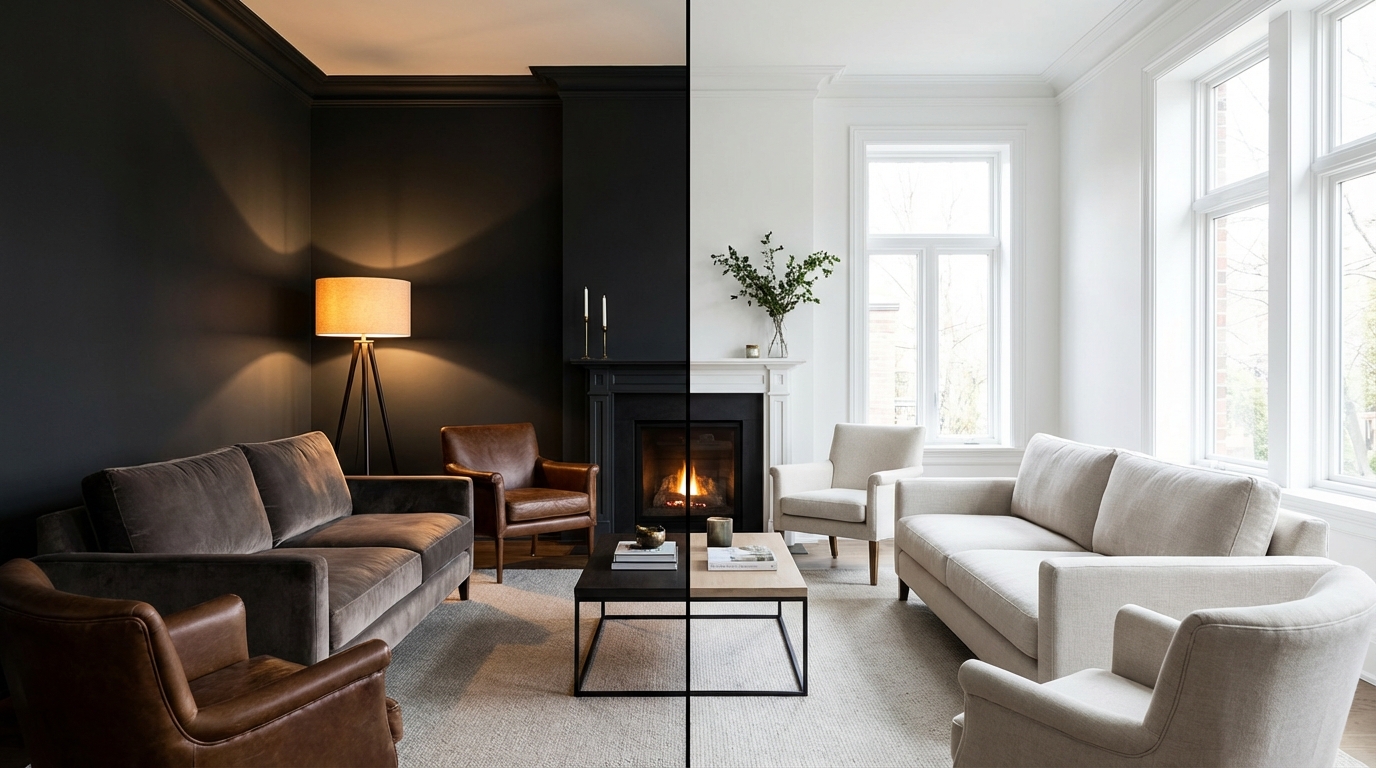
LRV (Light Reflectance Value) is the single most useful number for choosing paint colors. It measures how much light a color reflects, from 0 (pure black) to 100 (pure white). And it'll tell you more about how a color will look in your room than the actual color will.
I ignored LRV for years. Picked colors based on how they looked on chips, in stores, on Pinterest. You know what happened? I repainted rooms. A lot.
Once I started paying attention to LRV, my paint picks got dramatically better. Here's why it matters and how to use it.
What LRV actually tells you
LRV tells you how light or dark a color will feel on your walls—regardless of whether it's blue, green, gray, or beige. A pale blue with LRV 70 and a pale green with LRV 70 will feel equally light in a room, even though they're different colors.
This matters because:
- A dark color in a dark room = cave. No amount of loving that color will fix bad LRV math.
- Colors below LRV 50 change the mood significantly. They make rooms feel cozier, smaller, moodier.
- Your room's light dictates what LRVs will work. Not your preferences.
LRV reference table
| LRV | What It Feels Like | Works Best In |
|---|---|---|
| 80-100 | Bright, airy, opens space | Dark rooms, basements, small spaces |
| 60-80 | Light but with color | Most rooms, especially north-facing |
| 40-60 | Medium, noticeable color | Well-lit rooms, south-facing |
| 20-40 | Dark, moody, dramatic | Statement walls, cozy dens |
| 0-20 | Very dark, absorbs light | Only with excellent natural light |
Most popular wall colors live between LRV 50-75. Below 50, you're making a commitment. Above 80, you're basically in white territory.
How to actually use LRV
Step 1: Figure out your room's light situation
This is the part people skip. Don't skip it.
North-facing rooms get cool, indirect light. Colors look 5-10 LRV points darker than they actually are. A color rated LRV 60 might feel like LRV 50. You need LRV 60+ to avoid gloom.
South-facing rooms get warm, direct light. You can use almost any LRV—the light is forgiving. Medium colors (LRV 40-70) shine here.
East-facing rooms get morning sun, afternoon shadow. Colors shift throughout the day. Test extensively.
West-facing rooms get harsh afternoon light. Warm colors can become overwhelming. Consider slightly cooler or lighter choices.
Step 2: Match LRV to room function
Need brightness? (Kitchens, bathrooms, offices) → LRV 60-85
Need coziness? (Bedrooms, dens, dining rooms) → LRV 40-65
Making a statement? (Media rooms, powder rooms) → LRV 15-40
Step 3: Think about adjacent spaces
Open floor plans need LRV harmony. Colors with similar LRVs flow together, even if they're different hues.
My living room (LRV 65 greige) flows into my kitchen (LRV 70 white). The colors are different, but the similar reflectance creates continuity. If I'd done LRV 40 in the living room? Jarring transition.
Mistakes I made (so you don't have to)
Mistake #1: Ignoring LRV in a dark room
Painted my north-facing guest room a gorgeous "medium gray" without checking LRV. It was 45. Looked like a cave. Had to repaint with LRV 65.
Mistake #2: Mismatched trim
Standard white trim is LRV 85+. Painted my walls LRV 78 white. The trim looked dirty because there wasn't enough contrast. Should've gone with LRV 90+ trim or LRV 70 walls.
Mistake #3: Not testing at different times
My west-facing room looked perfect at 10am with a sample. By 4pm with harsh afternoon light, the color looked completely different. LRV doesn't change, but your perception of it does based on lighting.
Mistake #4: Assuming all rooms need the same LRV
My bedroom should be cozy. I painted it the same LRV as my bathroom (75) because I liked the color. Too bright for sleep. Should've gone 55-65.
LRV vs. undertones
People confuse these all the time.
LRV = how light or dark a color is Undertones = the hidden hues that show up in certain light
Two colors can have identical LRV but completely different undertones:
- Agreeable Gray SW 7029 (LRV 60) — warm, greige
- Passive SW 7064 (LRV 60) — cool, true gray
Same lightness. Totally different vibes. LRV gets you in the right ballpark. Undertones determine if you love or hate it.
Where to find LRV
Most manufacturers list it:
- On the back of paint chip cards
- On their websites
- In their apps
If you're using Muro to visualize colors, LRV shows up with each color's details. Handy for comparing options without doing mental math.
My LRV rules of thumb
The "50 Rule": If unsure, stay above LRV 50. Colors above 50 work in most lighting. Below 50, you need to know what you're doing.
The "10-Point Rule": For flowing spaces, keep LRVs within 10 points. A hallway at 72 → bedroom at 65 = smooth. Hallway at 72 → bedroom at 45 = jarring.
The "North Light Penalty": Subtract 5-10 points from rated LRV for north-facing rooms. That LRV 60 will feel like 50-55.
The "South Light Bonus": Add 5-10 points for south-facing rooms. That LRV 50 will feel like 55-60.
Check the number first
Before you fall in love with a color, check its LRV. A color with the wrong LRV for your room will always disappoint, no matter how good it looked on Pinterest.
The process:
- Assess your room's light
- Pick an LRV range that works
- Then choose colors within that range
- Test to confirm
LRV isn't fun. Nobody gets excited about a number on the back of a paint chip. But it's the difference between "I love this room" and "why does this feel wrong?"
Trust the numbers. Then trust your taste.