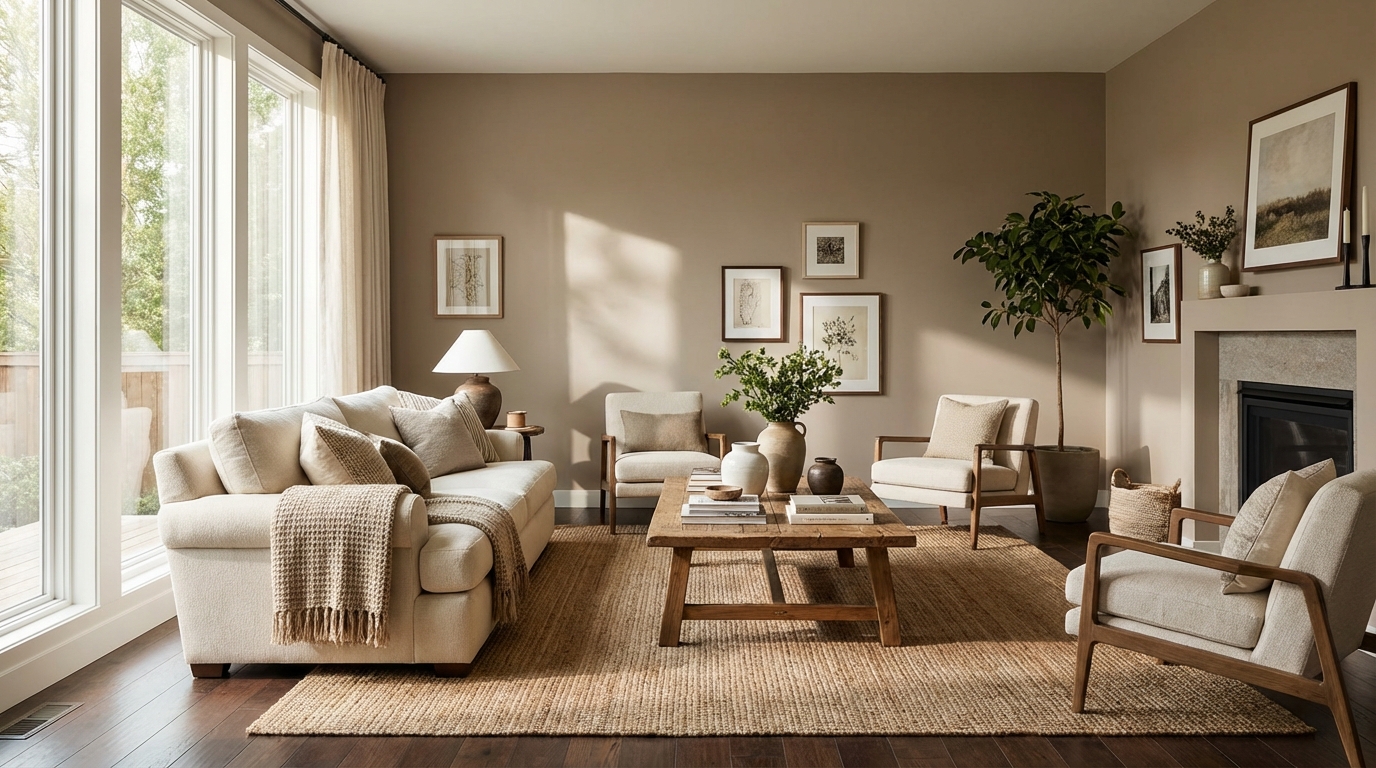
The best living room colors for 2026: warm whites, teal, sage-to-forest green, warm taupes, and tobacco brown. But the "best" color for YOUR living room depends on three things—how much natural light you get, what your furniture looks like, and whether you're going for cozy or airy.
I repainted my own living room last spring. Went from a cool gray (that I'd liked for about two years before it started depressing me) to a warm greige. The difference was instant. Same furniture, same rug, same art—but the room suddenly felt like somewhere I wanted to actually sit and hang out. Not just pass through on the way to the kitchen.
Living rooms are the hardest room to pick paint for because they do everything. You watch TV there, host people, read, nap, sometimes work. The color has to hold up across all of those moods.
What's Trending for Living Rooms in 2026
Warm Whites (Still the #1 Pick, But Warmer Than Before)
I know. "Paint your living room white" isn't exactly new advice. But the type of white matters more than ever.
The stark, bright whites of the 2010s minimalism era are out. What's in: buttery off-whites, oatmeal tones, warm creams. Whites that feel like natural sunlight, not hospital lighting.
Warm Whites Worth Trying:
- White Dove OC-17 (Benjamin Moore) — LRV: 85. The designer's warm white. Creamy without being yellow. Probably the single safest living room color in existence.
- Alabaster SW 7008 (Sherwin-Williams) — LRV: 82. Slightly warmer than White Dove. Beautiful in rooms with lots of natural light.
- Swiss Coffee OC-45 (Benjamin Moore) — LRV: 82. A touch more yellow than White Dove. Really nice in south-facing rooms. Can read as "dirty" in north-facing rooms though—ask me how I know.
Best for: Open-concept spaces, rooms with colorful furniture or art, anyone who wants a blank canvas that still feels warm.
Teal (The Bold Move Everyone's Talking About)
Teal is having a moment. Not the 1990s teal your aunt had in her guest bathroom. A smokier, more grown-up version. Think blue-green with enough gray to keep it grounded.
Designers keep bringing this up for 2026. And I get why—it's bold without being aggressive. Calming but not boring. It manages to work with both warm wood tones and cool metallics.
Teal-Family Colors Worth Trying:
- Riverway SW 6222 (Sherwin-Williams) — LRV: 11. Deep and moody. Best as a full-room color with good lighting.
- Aegean Teal 2136-40 (Benjamin Moore) — LRV: 24. The 2021 COTY that's still going strong. More approachable than Riverway.
- Hidden Gem N430-6A (Behr) — LRV: 12. The 2026 COTY. Smokier and more jade than traditional teal.
Best for: Separate living rooms (not open-concept), rooms with warm wood floors, anyone who wants personality without going full maximalist.
Warning: Teal in an open-concept space can be overwhelming if it flows into the kitchen. If you're open-concept, consider teal on one wall or in a defined seating area only.
Sage to Forest Green (The Range That Won't Quit)
Green has been trending for years now, and it's still going. But the shade is shifting. In 2023-2024, everyone went sage. Safe, pretty, Pinterest-approved sage. Now the spectrum is wider—from muted sage all the way to deep forest.
Green Colors Worth Trying:
- Evergreen Fog SW 9130 (Sherwin-Williams) — LRV: 30. The sweet spot between sage and forest. Moody enough to feel intentional, light enough to not eat your room.
- Saybrook Sage HC-114 (Benjamin Moore) — LRV: 45. If you want green but are nervous about going too dark. This is the gateway green.
- Warm Eucalyptus (Valspar) — LRV: ~28. The 2026 COTY pick. Works well in living rooms because it's warmer than most greens.
Best for: Rooms with warm-toned floors (wood, warm tile), nature lovers, anyone who's tired of neutral but not ready for something wild.
Warm Taupe & Greige (The New Neutral)
Cool gray is dead—I've said it before and the 2026 Color of the Year picks confirm it. Every single neutral that brands picked this year leans warm. Warm taupes, greiges, and mushroom tones are the new default.
Warm Neutral Colors Worth Trying:
- Accessible Beige SW 7036 (Sherwin-Williams) — LRV: 58. Warm enough to feel cozy, neutral enough to go with anything. The "I can't decide" color that's actually a great decision.
- Pale Oak OC-20 (Benjamin Moore) — LRV: 70. Lighter and more versatile. Works in almost any lighting condition.
- Universal Khaki SW 6150 (Sherwin-Williams) — LRV: 37. The 2026 COTY. Deeper and more intentional than a typical neutral. Great for living rooms where you want warmth without color.
Best for: Whole-house continuity, open-concept spaces, rooms with lots of different activities happening.
Tobacco Brown (The Unexpected One)
This one surprised me. But brown—specifically warm, tobacco-toned brown—is making a real comeback. Not the flat brown of '90s apartments. A richer, more layered thing with red or orange undertones.
Benjamin Moore's Silhouette (their 2026 COTY) is a brown-adjacent color. So is Clark + Kensington's Hazelnut Crunch. The industry is clearly pushing this direction.
Brown Colors Worth Trying:
- Smokey Topaz 2136-20 (Benjamin Moore) — LRV: 10. Deep and rich. Use it in a living room with good light and warm-toned furniture.
- Tiki Hut SW 7509 (Sherwin-Williams) — LRV: 16. Warm, slightly reddish. Think leather and whiskey.
- Kona AS-32 (Benjamin Moore) — LRV: 4. Very dark—only for the brave and well-lit.
Best for: Formal living rooms, rooms with lots of natural light, anyone who wants warmth without going the safe neutral route.
How to Choose Based on Your Living Room
Your Room Faces North
North-facing rooms get cool, bluish light. This is the room that makes warm colors look weird and cool colors look sad.
Go with: Warm whites (White Dove, Alabaster) or warm neutrals (Pale Oak, Accessible Beige). The warmth in the paint counteracts the coolness of the light. Avoid teal and forest green here unless you have really good artificial lighting.
Your Room Faces South
South-facing rooms are flooded with warm light. Lucky you. Almost anything works.
Go with: You've got options. Greens look amazing here. Teal works beautifully. Even tobacco brown can work. Just avoid colors that are already very warm (like orange-toned browns) or they can read as too hot.
You Have an Open Concept Layout
The challenge: your living room paint has to play nice with the kitchen and dining area.
Go with: Warm neutrals are your friend. Pale Oak, Accessible Beige, or Universal Khaki will flow from room to room without clashing with kitchen cabinets or dining room furniture. Save the bolder colors for defined spaces.
You Have Dark Furniture
Dark furniture (leather sofa, dark wood coffee table) against dark walls can feel heavy. But it can also look great if you commit to it.
Go with: Either go light (warm white, light greige) for contrast, or lean into it with a medium-toned green or taupe. The worst move is going almost as dark as your furniture—then nothing has definition.
You Have Colorful Art or Textiles
If your living room personality comes from art, pillows, and rugs, your walls should be the supporting cast, not the star.
Go with: Warm whites or light neutrals. Let the art do the talking. A bold wall color competing with colorful art creates visual chaos.
The Finish Matters Too
For living rooms, eggshell is the standard. It's got just enough sheen to be wipeable (important with kids and pets) but not so much that it highlights every wall imperfection.
Some people go matte for a more sophisticated look. Just know that matte shows scuffs and isn't as easy to clean. Fine for formal living rooms. Less fine for the room where your kids eat popcorn.
If you're doing color drenching (walls, ceiling, trim all the same color), use matte on walls and ceiling, satin on trim. See my full color drenching guide for details.
Don't Just Pick a Color—Test It
Living rooms are where you'll spend the most time looking at the color. A bad bedroom color is annoying. A bad living room color is depressing.
Buy at least two sample pots and paint large swatches on opposite walls. Check them at different times of day. The color that looks perfect at noon might turn weird under your evening lamps.
Better yet, start by previewing colors digitally with Muro before spending anything on samples. It won't replace physical testing, but it'll get you from "I have no idea" to "I'm choosing between these two" much faster.
The Bottom Line
The living room is not the place for your wildest paint experiments (save that for the powder room). But it also doesn't have to be boring white.
In 2026, the move is warmth. Warm whites, warm neutrals, warm greens. Even the bold colors—teal, tobacco brown—lean warm. Cool, sterile living rooms are done.
Pick a color that makes you want to sit down and stay awhile. That's the only test that really matters.