Hot take: the single accent wall is the mullet of interior design. It was cool once. It served a purpose. But we've moved on, and in 2026, there are better ways to add color and drama to a room.
OK, that's maybe a little harsh. The accent wall isn't completely useless. But the way most people do it—one wall a random bold color, the other three white—has become the default "I want color but I'm scared" move. Designers have been quietly rolling their eyes at it for years. Now the alternatives have gotten good enough that even DIYers can level up.
I'll admit, I had an accent wall in my bedroom for three years. Deep navy behind the headboard, warm white everywhere else. It looked fine. But when I eventually painted the whole room a consistent warm color, the difference was night and day. The accent wall made the room feel like it had a feature. The full color treatment made the room feel like it had a mood.
Let me show you what's replacing the single accent wall—and why each option is better.
Why the Single Accent Wall Fell Out of Favor
A few reasons:
It's become a cliché. When literally every apartment and home staging uses the same formula (one colored wall behind the bed/sofa, everything else white), it stops feeling like a design choice and starts feeling like a default. The point of an accent wall was to make a statement. When everyone's making the same statement, it's no longer a statement.
It can feel disjointed. One dramatically different wall often makes a room feel like two rooms that got confused. Instead of cohesion, you get "colorful wall + bland room." The eye bounces between the feature and the nothing.
It's the minimum viable color. An accent wall says "I wanted to add color but didn't want to commit." And there's nothing wrong with dipping your toes in. But if you actually want color in your life, there are bolder, more intentional ways to do it.
Designers caught on to better techniques. The real reason. Color drenching, color capping, two-tone walls, and architectural color blocking all look more intentional. They just needed time to trickle down from high-end projects to everyday homes.
Alternative 1: Color Drenching
What it is: Painting walls, ceiling, and trim all the same color. Total immersion.
Why it's better than an accent wall: Instead of painting ONE surface, you transform the ENTIRE room into an experience. The edges disappear, the room becomes a cocoon, and the result feels 10x more designed.
Best for: Dining rooms, bedrooms, powder rooms, home offices.
The starter version: If full drenching feels too bold, drench just one room—the powder room. Paint everything (walls, ceiling, trim, even the door) in Hidden Gem or Hale Navy. The effect in a small space is wild.
I've written a full color drenching guide if you want the complete walkthrough. The key insight: vary your sheen (matte on walls, satin on trim) even though the color stays the same.
Alternative 2: Color Capping
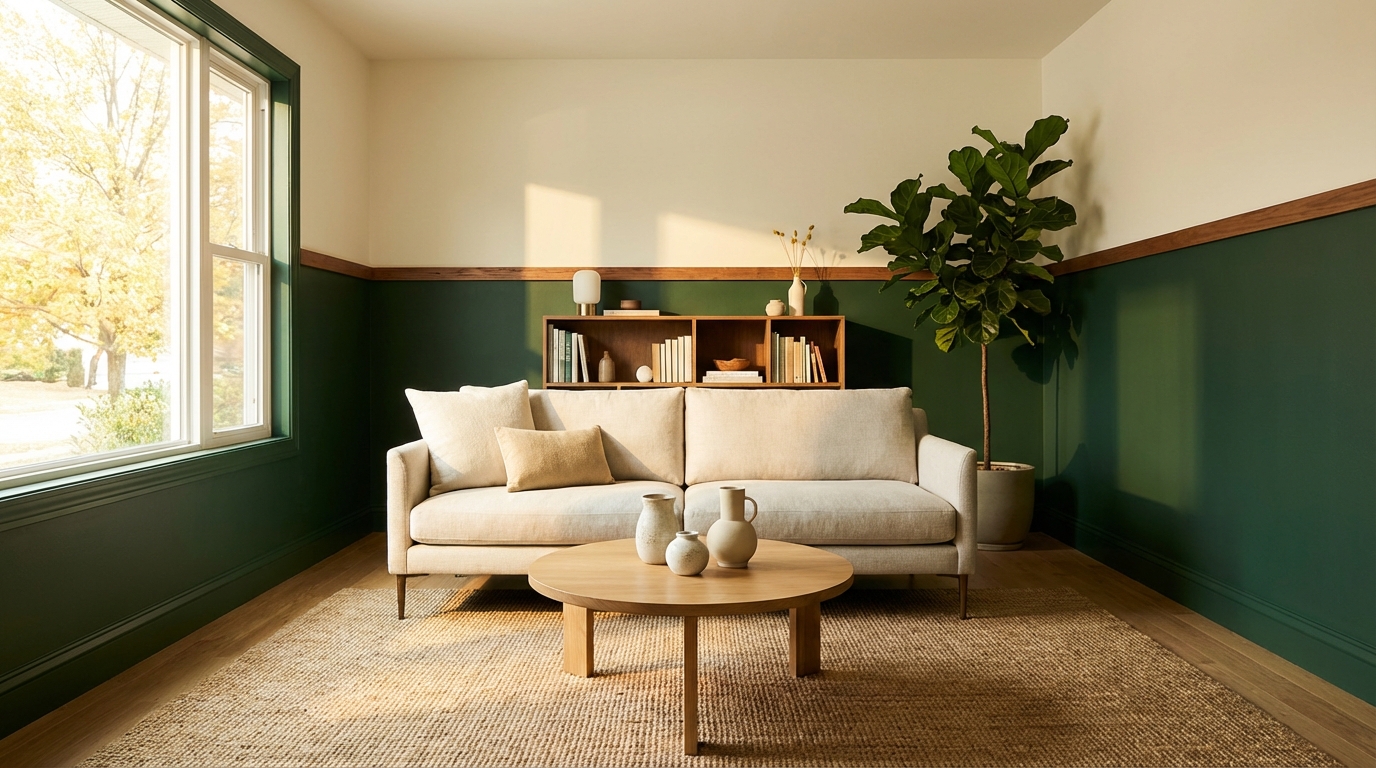
What it is: Painting the lower portion of your wall a color (to about chair-rail or two-thirds height), then painting the upper portion and ceiling the same lighter color. It creates a "cap" of the lighter shade.
Why it's better than an accent wall: Color capping adds visual interest to ALL four walls without overwhelming the space. The horizontal division looks architectural, even if you don't have actual chair rail molding.
How to do it:
- Decide your height. Chair-rail height (about 36 inches from the floor) is classic. Two-thirds up the wall (about 64 inches in a standard 8-foot room) is more contemporary.
- Tape a clean line using painter's tape.
- Paint the bottom section in your chosen color.
- Paint the top section and ceiling in a warm white or the lighter shade.
Best colors for the lower section:
- Forest green or jade (the lower section feels grounding)
- Warm taupe or mushroom (subtle but sophisticated)
- Deep navy (classic, almost nautical)
Best for: Living rooms (adds color without overwhelming an open space), bedrooms (calming, and you see the color from bed height), kids' rooms (fun and practical—put the dark color on the lower walls where scuffs happen).
Pro tip: If you have an actual chair rail, paint above and below it different colors. The molding creates a natural, polished transition. If you don't have a chair rail, a crisp tape line works just as well.
Alternative 3: Two-Tone Walls
What it is: Painting the top and bottom halves of every wall in two different (but coordinating) colors. Similar to color capping but with two distinct colors rather than a color and a neutral.
Why it's better than an accent wall: It wraps the entire room in color—not just one wall. The two-tone approach gives you contrast AND cohesion.
How to do it:
- Choose two colors that share an undertone family. A deep green bottom with a sage top. A navy bottom with a dusty blue top. A warm brown bottom with a warm cream top.
- The darker color goes on the bottom. Always. Dark on top feels top-heavy and unsettling.
- Divide at chair-rail height or slightly above.
Winning combinations:
- Hunt Club (bottom) + Saybrook Sage (top) — green spectrum from dark to light
- Hale Navy (bottom) + Nimbus Gray (top) — blue depth to blue-gray lightness
- Urbane Bronze (bottom) + Accessible Beige (top) — warm browns, light to dark
- Silhouette (bottom) + White Dove (top) — dramatic to clean
Best for: Bedrooms, dining rooms, hallways. Rooms where you want presence without painting every surface dark.
Alternative 4: Architectural Color Blocking
What it is: Using paint to highlight or create architectural features. Painting a recessed area, a built-in bookshelf, or the wall behind a nook a different color from the surrounding walls. It's an "accent" approach, but tied to architecture rather than arbitrarily choosing one wall.
Why it's better than a random accent wall: The color has a reason. It's not "I picked the wall behind the couch." It's "I painted the inside of the built-in shelves deep green to create depth" or "I painted the breakfast nook a warm color to define the space."
Ideas:
- Paint the inside of built-in shelving a deep color (this is SO good—books and objects pop against dark backgrounds)
- Paint a recessed wall or alcove a contrasting color
- Paint the wall behind open shelving
- Define a dining nook or window seat with color
- Paint a coffered ceiling or ceiling beams a contrasting tone
Best for: Homes with architectural features (even small ones), open-concept spaces where you want to define zones without physical barriers.
Alternative 5: Contrasting Trim
What it is: Instead of coloring the walls, make the trim, door frames, and doors the statement. Keep walls a warm neutral or white. Paint all trim in a deep color—black, navy, forest green, or even the 2026 trending charcoal brown.
Why it's better than an accent wall: It's architectural detail work. It makes the bones of the room stand out rather than the flat surfaces. The result looks more polished, more permanent, like the house was designed that way.
Best trim colors for 2026:
- Iron Ore SW 7069 (Sherwin-Williams) — LRV: 6. A near-black with warm undertones. The most popular dark trim color for a reason.
- Wrought Iron 2124-10 (Benjamin Moore) — LRV: 5. Similar to Iron Ore but slightly cooler.
- Hale Navy HC-154 (Benjamin Moore) — LRV: 6. Navy trim is unexpected and beautiful.
- Silhouette AF-655 (Benjamin Moore) — LRV: ~8. The 2026 COTY on trim. Subtle and really sharp.
Best for: Homes with lots of molding and trim work, modern farmhouse style, anyone who wants drama without painting walls a bold color.
Important: Dark trim needs to be in satin or semi-gloss finish. It highlights the architectural detail and is easier to clean.
When an Accent Wall STILL Works
I'm not saying accent walls are 100% dead. There are specific situations where one colored wall still makes sense:
- Behind a fireplace. A fireplace wall is an architectural feature. Coloring it is color blocking, not lazy accent walling.
- In an extremely open space where you need to define a zone without physical walls.
- When the wall has a specific feature like built-in shelving, a large window arrangement, or interesting molding.
- In a rental where you can only modify one wall due to lease restrictions.
The key difference: when the accent wall has a reason beyond "I wanted one wall to be different," it can still work.
How to Pick Your New Approach
Not sure which alternative to try? Here's a quick guide:
| Your Situation | Best Alternative |
|---|---|
| Small room, want drama | Color drenching |
| Large room, want subtle interest | Color capping |
| Bedroom, want color without overwhelm | Two-tone walls |
| Open concept, need to define zones | Architectural color blocking |
| Love your wall color, want more polish | Contrasting trim |
| Kids' room, want fun + practical | Color capping (dark on bottom, light on top) |
Preview Before You Commit
All of these techniques involve more paint than a single accent wall. That means more commitment and more cost if you change your mind.
Before you tape off that two-thirds line or buy four gallons for a color drench, preview the result. Take a photo of your room and try the color digitally with Muro. See if the vibe is what you're imagining. It's the fastest way to go from "I think this would look good" to "I can see that this looks good."
The Bottom Line
The single accent wall was a stepping stone. It helped people get comfortable with color. But in 2026, the options are just better.
Color drenching for immersion. Color capping for elegance. Two-tone walls for interest. Architectural blocking for intentionality. Contrasting trim for subtlety.
Pick the one that matches your courage level and your room's architecture. Any of them will look more intentional and more designed than a single navy wall behind your headboard.
Time to upgrade.