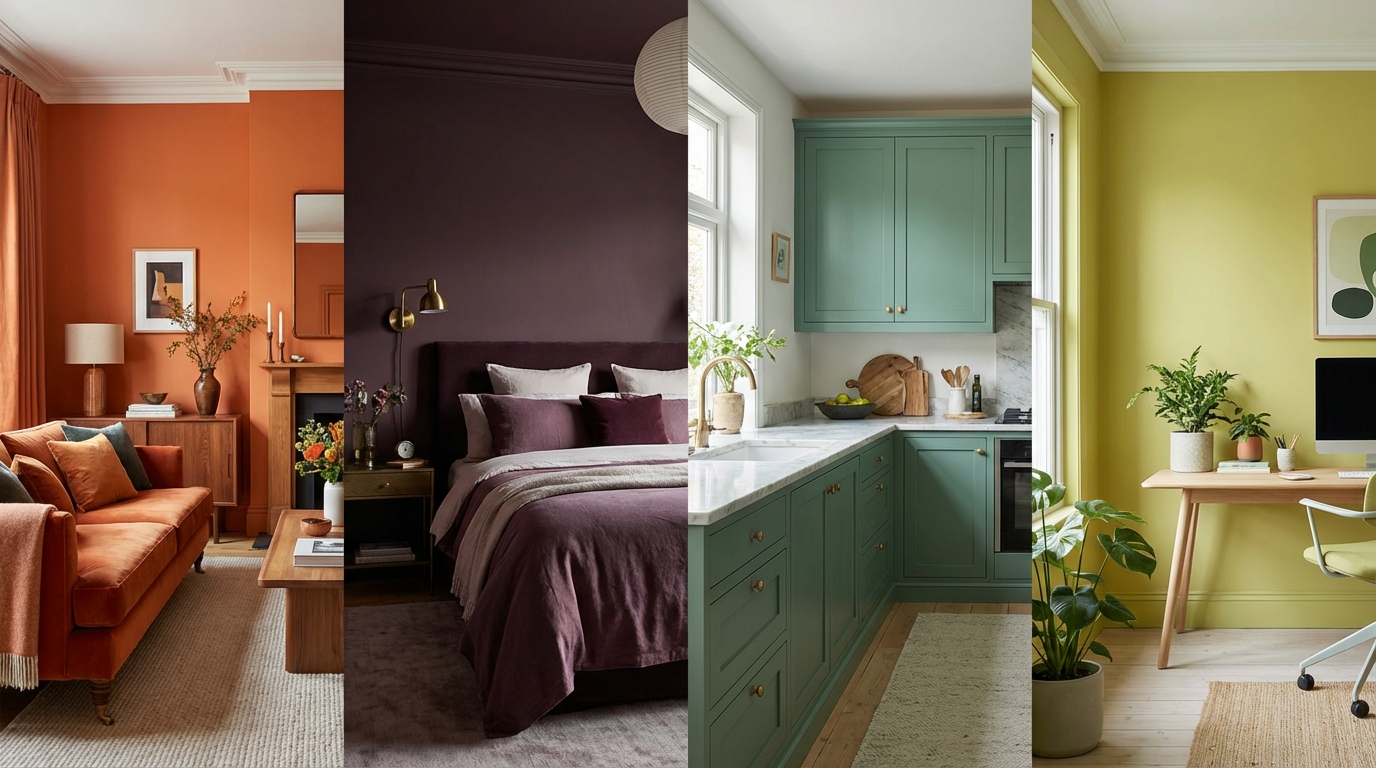
Pinterest dropped their 2026 color palette and it's... bold. Five colors: Persimmon, Cool Blue, Plum Noir, Jade, and Wasabi. According to their data, plum searches are up 220%, chartreuse (which maps to wasabi) is up 175%, and jade saves jumped 125%.
But here's what Pinterest won't tell you: not all trending colors make good wall paint.
Some of these translate beautifully to interiors. Others are better left as throw pillow colors. And a couple will look phenomenal—but only in very specific rooms under very specific conditions.
I went through each one, found the closest paint equivalents, and tested them. Let me save you the guesswork.
1. Jade — The Winner
Verdict: GREAT wall color. Go for it.
Jade is the easiest Pinterest pick to translate to real paint. It's basically what Behr already did with Hidden Gem (their 2026 Color of the Year)—a deep, smoky blue-green that feels calm and sophisticated.
Jade has been building momentum for three years now. Pinterest search data shows saves up 125%, and paint companies clearly agree since multiple brands chose jade-adjacent greens for 2026.
Closest paint matches:
- Hidden Gem N430-6A (Behr) — LRV: 12. The best match. Smoky jade that's deep without being black.
- Aegean Teal 2136-40 (Benjamin Moore) — LRV: 24. Lighter and more blue, but in the same family.
- Riverway SW 6222 (Sherwin-Williams) — LRV: 11. Deeper and more dramatic.
Where it works on walls:
- Bedrooms (creates a very calm sleeping environment)
- Home offices (focus-enhancing without being stimulating)
- Dining rooms (moody and intimate by candlelight)
- Bathrooms (spa vibes immediately)
Where it doesn't work:
- Windowless rooms (LRV 11-12 needs some natural light)
- Open-concept living areas (too strong to flow into the kitchen)
Pair with: Warm white trim, brass fixtures, warm wood. Jade + brass is one of the best combinations in interior design right now.
2. Plum Noir — The Bold Bet
Verdict: Incredible in the right room. Handle with care.
Plum Noir is Pinterest's fancy name for deep, dark plum-purple. Think the color of a good Malbec. Searches up 220%—the biggest increase of all five colors. Graham & Brown already validated this by choosing Divine Damson (a similar deep plum) as their 2026 Color of the Year.
This is the most dramatic option on the list. It's not a "paint the whole house" color. But in the right space, it stops you in your tracks.
Closest paint matches:
- Black Raspberry 2072-20 (Benjamin Moore) — LRV: 5. Deep plum-black. Very dramatic.
- Chambourd AF-645 (Benjamin Moore) — LRV: 5. A bit warmer and more wine-toned.
- Plummy (Farrow & Ball) — LRV: ~5. The British take, with depth and complexity.
Where it works on walls:
- Powder rooms (the absolute best room for this color)
- Dining rooms (candlelight makes plum glow like nothing else)
- Bedrooms (romantic, cocooning—if you can commit)
- Feature walls in living rooms
Where it doesn't work:
- Kitchens (plum + food is weird visually)
- Kids' rooms (too somber)
- Home offices (can feel heavy during long work sessions)
- Any room with cool-toned lighting (plum under cool LEDs looks sickly)
The lighting requirement: Non-negotiable warm bulbs. 2700K LED. Plum in warm light glows. Plum in cool light looks like a bruise. There's no middle ground.
Pair with: Gold and brass hardware, velvet textures, cream and ivory accents. NOT silver or chrome—that kills the warmth.
3. Persimmon — Proceed With Caution
Verdict: Better as an accent than a full wall color. Tricky on walls.
Persimmon is a warm, reddish-orange. Think burnt sunset, autumn leaves, that specific shade of rust-orange that's been showing up in fashion. On Pinterest? Gorgeous on mood boards. On four walls of your living room? Potentially overwhelming.
I'm not saying persimmon can't work on walls. I'm saying it's the hardest of the five Pinterest colors to execute well. Orange-family paints are the most affected by lighting conditions. They can shift from "warm and inviting" to "this room is on fire" depending on the time of day.
Closest paint matches:
- Cavern Clay SW 7701 (Sherwin-Williams) — LRV: 23. The most livable version. More terracotta than pure persimmon. This actually works.
- Potters Clay 1221 (Benjamin Moore) — LRV: 19. Slightly deeper and more brown. Safer than a true orange.
- Roasted Pepper 22 (Benjamin Moore) — LRV: 12. Deeper, more brown-red. Less aggressively orange.
Where it works on walls:
- South-facing dining rooms (afternoon light tames the intensity)
- Exterior front doors (instant curb appeal)
- Accent walls paired with warm neutrals
- Small nooks or reading corners
Where it's risky:
- North-facing rooms (cool light + warm orange = muddy)
- Large walls in bright rooms (can feel overpowering)
- Bedrooms (too stimulating for sleep)
My honest take: If you love persimmon, go for a muted, browner version like Cavern Clay rather than a true bright orange. The terracotta-ized version has the same warmth with much better livability. A true, bright persimmon belongs on your throw blanket, not your walls.
Pair with: Cream, warm white, tan leather, natural wood. Keep everything else calm to balance the warmth.
4. Cool Blue — The Reliable One
Verdict: Always works. But not very exciting.
Cool Blue is the least controversial pick on Pinterest's list. A mid-tone, slightly grayed blue. Think denim, dusty sky, vintage workwear. It's pretty. It's safe. It's... okay?
I don't mean that dismissively. Blue is consistently the most-liked color across all demographics and cultures. It's almost impossible to screw up a well-chosen blue. The downside: it's not going to get you the "wow, that room is incredible" reaction that jade or plum noir will.
Closest paint matches:
- Nimbus Gray 2131-50 (Benjamin Moore) — LRV: 42. A grayed-out blue that feels grown-up. The adult version of Cool Blue.
- Debonair SW 9139 (Sherwin-Williams) — LRV: 35. Slightly more saturated. More clearly "blue."
- Denim Blue 2059-40 (Benjamin Moore) — LRV: 21. Darker, moodier. More statement.
Where it works on walls:
- Literally anywhere. Bedrooms, living rooms, kitchens, bathrooms. Blue is universally safe.
- North-facing rooms (blue reads well in cool light, unlike warm colors)
- Kids' rooms (calming without being babyish)
Where it might disappoint:
- If you want drama (cool blue is inherently understated)
- If you have cool-toned furniture (blue on blue can feel monotonous)
Pair with: Warm wood tones (the warm/cool contrast works really well), white trim, brass accents, natural fibers.
5. Wasabi — The Wildcard
Verdict: On walls? Highly depends. This is the trickiest one.
Wasabi is essentially a yellow-green. Chartreuse territory. Pinterest says chartreuse searches are up 175%, and I believe it—as a fashion and graphic design color. On walls? That's a different conversation.
Yellow-greens are the most divisive colors in interior design. Some people see "fresh, energetic, modern." Other people see "baby food." There's very little middle ground with this one.
Closest paint matches:
- Dill Pickle SW 9025 (Sherwin-Williams) — LRV: 26. The least aggressive wasabi. More muted, more livable.
- Mesquite SW 6531 (Sherwin-Williams) — LRV: 18. Deeper and more olive-toned. Pushes away from true chartreuse.
- Dark Celery 2146-10 (Benjamin Moore) — LRV: 10. Very dark, more green than yellow. The moodiest interpretation.
Where it might work on walls:
- Eclectic, maximalist spaces (where it's part of a larger color story)
- Sunrooms and garden rooms (the green-yellow connects to plants)
- One accent wall paired with lots of white
- Modern kitchens with dark cabinets (as a pop of energy)
Where it almost certainly doesn't work:
- Full four-wall coverage in most rooms (too intense)
- Bedrooms (too stimulating, and yellow-green reads differently at night)
- Formal spaces (dining rooms, living rooms—too casual and quirky)
My honest take: Wasabi is a "social media color." It photographs well, it pops on a screen, and it'll get likes on your Instagram reel. Living with it daily is a different thing. If you want the energy of wasabi, I'd use it on furniture, cabinets, or a single accent wall—not all four walls.
Pair with: Black and white (for maximum graphic impact), warm wood, navy blue (a combo that works better than you'd expect).
The Pinterest Palette as a Whole-House Strategy
Could you use all five Pinterest colors across different rooms? Technically yes. But that would be... a lot. Here's a more realistic approach:
Pick ONE bold color (jade or plum noir) for a statement room. Use cool blue or a neutral in your main living spaces. Then bring in persimmon and wasabi as accent colors through textiles, art, and decor.
Example whole-house flow:
- Living room: Cool Blue (Nimbus Gray) on walls
- Dining room: Jade (Hidden Gem) — color drenched
- Bedroom: Jade or a neutral
- Powder room: Plum Noir (Chambourd)
- Kitchen: Neutral walls, persimmon accessories
- Home office: Jade or cool blue
Testing Pinterest Colors Before You Buy
These are all strong colors with strong opinions. A small swatch won't tell you enough. Before you buy paint:
-
Start digital. Open Muro and try the color on your actual walls. See how it interacts with your lighting, your floor, your furniture. Five minutes of digital testing saves hours of regret.
-
Buy one sample, not three. Once you've digitally narrowed to your favorite, buy one sample pot. Paint a BIG swatch (2x2 feet minimum) and live with it for 3 days.
-
Check at night. These bold colors shift dramatically between daylight and artificial light. Plum Noir at 2 PM and Plum Noir at 9 PM are basically different colors.
The Bottom Line
Pinterest's 2026 palette is bold—bolder than most people will actually paint their walls. And that's fine. The value is in the direction it points: toward richer, warmer, more saturated color choices.
Jade is the standout pick. It's the one that translates best from Pinterest board to real wall. Plum Noir is the showstopper for brave souls. Cool Blue is the reliable friend. Persimmon and Wasabi are best enjoyed in smaller doses.
Don't paint your entire house based on a Pinterest trend. But do let it push you past the "everything should be white or gray" mindset. There are a lot more good options than most people realize, and 2026 is a good year to try something different.