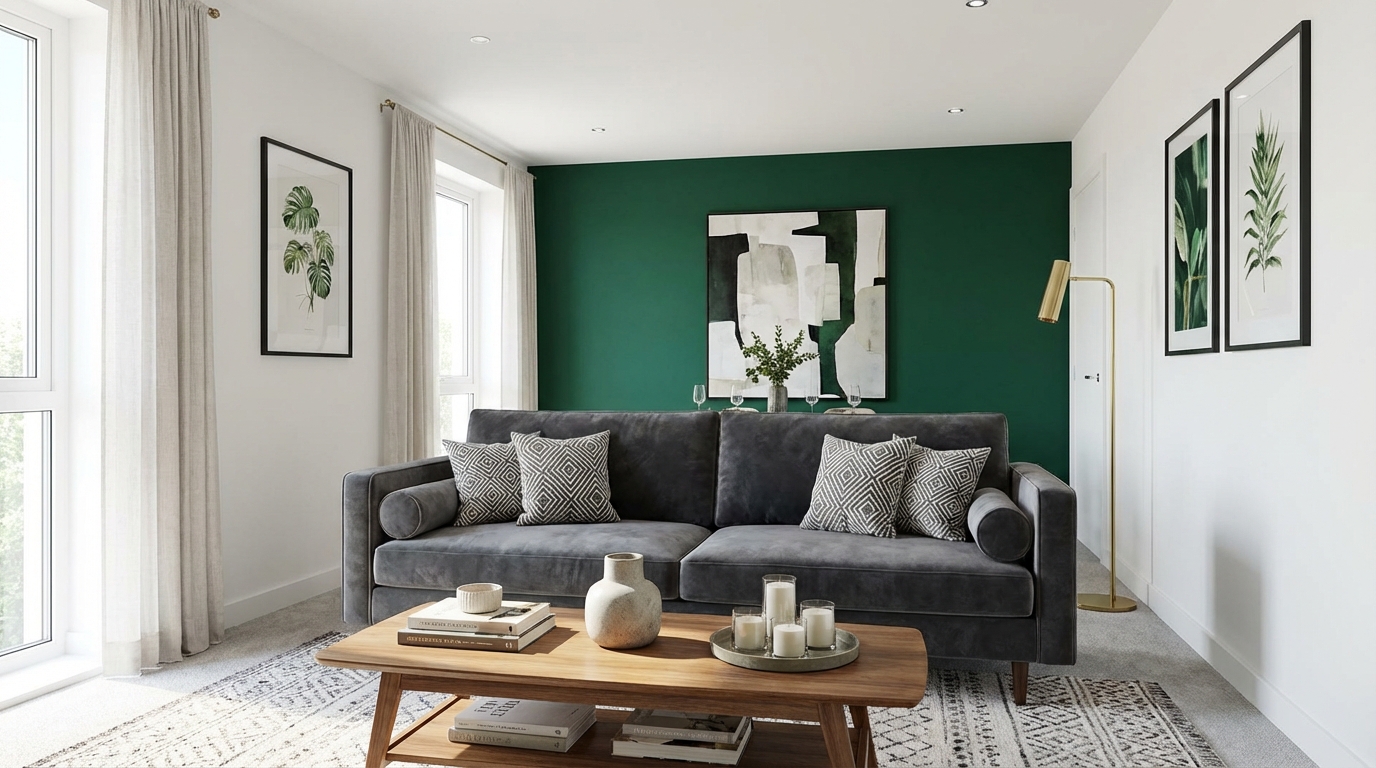
The best accent wall is the one you see when you enter the room, painted 2-3 shades darker than your main walls. That's the formula designers use. Ignore the TikTok advice about painting random walls in bold colors because it "adds personality." That's how you end up with a wall that looks like a mistake.
I painted an accent wall in a bathroom once because a friend said it would "pop." It popped alright. It made a small bathroom feel even smaller and the accent wall looked like I ran out of paint before finishing. Took me two years to get around to fixing it.
Where to put an accent wall
Location matters more than color. Put the accent wall in the wrong spot and no color will save it.
The wall you see first
When you walk into a room, your eye goes somewhere first. That's where your accent wall should be. It's usually:
- The wall directly opposite the entrance
- The wall behind the main piece of furniture (bed, sofa, dining table)
- The wall with the fireplace
These are natural focal points. An accent wall here reinforces what your eye already wants to do.
The architectural feature wall
If a wall has a fireplace, built-in shelves, or interesting architectural details, that's a natural accent wall candidate. The color draws attention to the feature.
Works well:
- Fireplace surrounds
- Built-in bookcases
- Walls with interesting molding
- Alcoves and niches
The wall that needs help
Sometimes a room has a wall that feels like dead space. No windows, no features, just blank wall. An accent color can give it purpose without adding furniture.
But be careful here. Don't use accent paint to fix bad room layouts. If the wall is awkward, paint might just highlight the awkwardness.
Where NOT to put an accent wall
Random walls
"I'll just paint this wall because it's easy to reach."
Bad idea. An accent wall needs to make visual sense. If it doesn't relate to the room's focal point, it looks random and confusing.
Multiple accent walls
One accent wall creates a focal point. Two accent walls create confusion. If you want color on multiple walls, just paint the whole room that color.
Small rooms (usually)
In small rooms, accent walls can make the space feel choppy and even smaller. The color contrast breaks up the visual flow.
Exception: a slightly darker accent wall on the far wall can create depth and make the room feel longer.
Walls with lots of interruptions
Windows, doors, outlets, switches, artwork. If the wall is already busy, an accent color adds to the chaos. Pick a wall with clean, uninterrupted space.
How to choose the accent color
The 2-3 shades darker rule
This is the safest approach and it almost always works.
Take your main wall color. Find a color 2-3 shades darker on the same color strip. Use that for your accent wall.
Example: Main walls: Agreeable Gray by Sherwin-Williams (SW 7029) Accent wall: Dovetail by Sherwin-Williams (SW 7018) or Gauntlet Gray by Sherwin-Williams (SW 7019)
This creates depth without drama. The colors relate to each other naturally because they share the same undertones.
The complementary color approach
For more impact, choose a color that complements your main walls.
Warm gray walls? Try a deep blue or green accent. Beige or cream walls? Try a deep terracotta or olive. Cool white walls? Try a warm wood tone or earthy clay color.
This takes more confidence but can look really good when done right.
The bold statement
Going full bold? Navy, black, dark green, deep burgundy. These work, but the room needs to support them.
Bold accent walls work when:
- The room has lots of natural light
- The ceiling is high (9+ feet)
- You have white or light trim to contrast
- The other walls are a clean, light neutral
Bold accent walls fail when:
- The room is already dark
- Other colors compete for attention
- There's no white or light element to provide contrast
Colors that work as accent walls
Reliable choices:
Hale Navy by Benjamin Moore (HC-154) - The classic navy that works everywhere
Iron Ore by Sherwin-Williams (SW 7069) - Dark charcoal, nearly black
Evergreen Fog by Sherwin-Williams (SW 9130) - Moody sage green
Urbane Bronze by Sherwin-Williams (SW 7048) - Warm, refined brown-gray
Kendall Charcoal by Benjamin Moore (HC-166) - Deep gray with subtle warmth
Accent wall mistakes to avoid
Mistake 1: Going too bold too fast
You saw a dramatic black accent wall on Pinterest and now you want one. But that photo had professional lighting, carefully curated furniture, and probably some Photoshop.
Solution: Test the bold color with Muro first. See how it looks in your actual space with your actual furniture. Bold colors look different in real rooms.
Mistake 2: Ignoring undertones
Your gray walls have blue undertones. Your accent wall is a brown-gray. They clash because the undertones fight each other.
Solution: Match undertones. Blue-gray walls get a deeper blue-gray accent. Warm greige walls get a deeper warm accent.
Mistake 3: Forgetting about trim
Dark accent walls need white or light trim to pop. If your trim is already painted a color, or if you're skipping trim paint, the accent wall can look muddy.
Mistake 4: The halfway accent
Painting half a wall, stopping at a chair rail, or painting just above the fireplace mantel. These rarely look intentional. They look like you couldn't decide.
Full wall or no wall. Commit.
Mistake 5: Too many competing colors
Accent wall in navy, main walls in beige, trim in white, ceiling in pale blue, built-ins in green. That's not an accent wall, that's a crayon box.
An accent wall should be the ONLY accent. Everything else plays supporting role.
Accent walls by room
Living room
The best spot is behind the sofa or the fireplace wall. Go for deep blues, dark greens, or dark grays. Avoid reds and oranges — too stimulating for a relaxation space.
Bedroom
Put it behind the headboard. Moody blues, deep greens, and warm neutrals all work well. The bedroom accent wall shouldn't face you when you're in bed. That's too much visual stimulation. Put it behind you.
Dining room
The wall you see from the table or behind a buffet/sideboard works best. Saturated colors work well here — dining rooms can handle drama. This is where you can go bold. Deep red, forest green, navy. Dining rooms are meant for atmosphere.
Home office
Put it on the wall behind your desk (what shows on video calls) or the wall you face while working. Blues and greens are great for focus. Avoid anything too dark that might feel oppressive during long work days.
Bathroom
Generally skip the accent wall. Bathrooms are small and already have visual interruptions (mirror, fixtures, tiles). Adding an accent wall can feel cluttered.
Exception: Large primary bathrooms with a freestanding tub. The wall behind the tub can handle an accent color.
The painted ceiling alternative
Instead of an accent wall, consider painting the ceiling the accent color. This works especially well in:
- Rooms with high ceilings (brings them down to a cozier height)
- Rooms where all walls have windows or doorways
- Rooms where you want drama without obvious accent walls
Use the same 2-3 shades darker rule. The effect is subtle but polished.
So what actually works
An accent wall should answer the question "What do you want people to look at?" Put it where the eye naturally goes. Make it 2-3 shades darker than your main walls for easy success, or go bold if you have the light and height to support it.
One accent wall maximum. Make sure undertones match. Use light trim for contrast.
And if you're not sure? It's better to skip the accent wall entirely than to create one that looks like a mistake. A room with consistently colored walls always looks more intentional than a room with a confusing accent.