Square footage for production work, day rate for complex projects. Most painters underprice because they forget about prep time, or overprice and lose bids. Here's how to calculate pricing that wins jobs and keeps you profitable.
I lost money on my first three painting jobs. Quoted based on "feel," didn't account for a 10-foot ceiling, and completely forgot to factor in the two days of wallpaper removal the client "assumed" was included. Learned fast that winging your pricing is how you end up working for free.
The two pricing models
Square foot pricing
Best for:
- Standard rooms with 8-9 foot ceilings
- Walls in reasonable condition
- New construction or repaints
- Production work (multiple similar rooms)
Typical ranges (US markets, 2026):
| Condition | Price per sq ft |
|---|---|
| New drywall (prime + 2 coats) | $2.50 - $4.00 |
| Repaint, good condition | $1.75 - $3.00 |
| Repaint, needs repair | $2.50 - $4.50 |
| Ceilings | $1.00 - $2.00 |
| Trim (linear foot) | $1.00 - $2.50 |
Day rate / hourly pricing
Best for:
- Complex prep work
- High ceilings requiring lifts
- Detailed trim and molding
- Color changes from dark to light
- Rooms with lots of cut-in work
Typical day rates (US markets, 2026):
| Experience Level | Daily Rate |
|---|---|
| Apprentice | $200 - $300 |
| Journeyman | $350 - $500 |
| Master / Specialty | $500 - $800 |
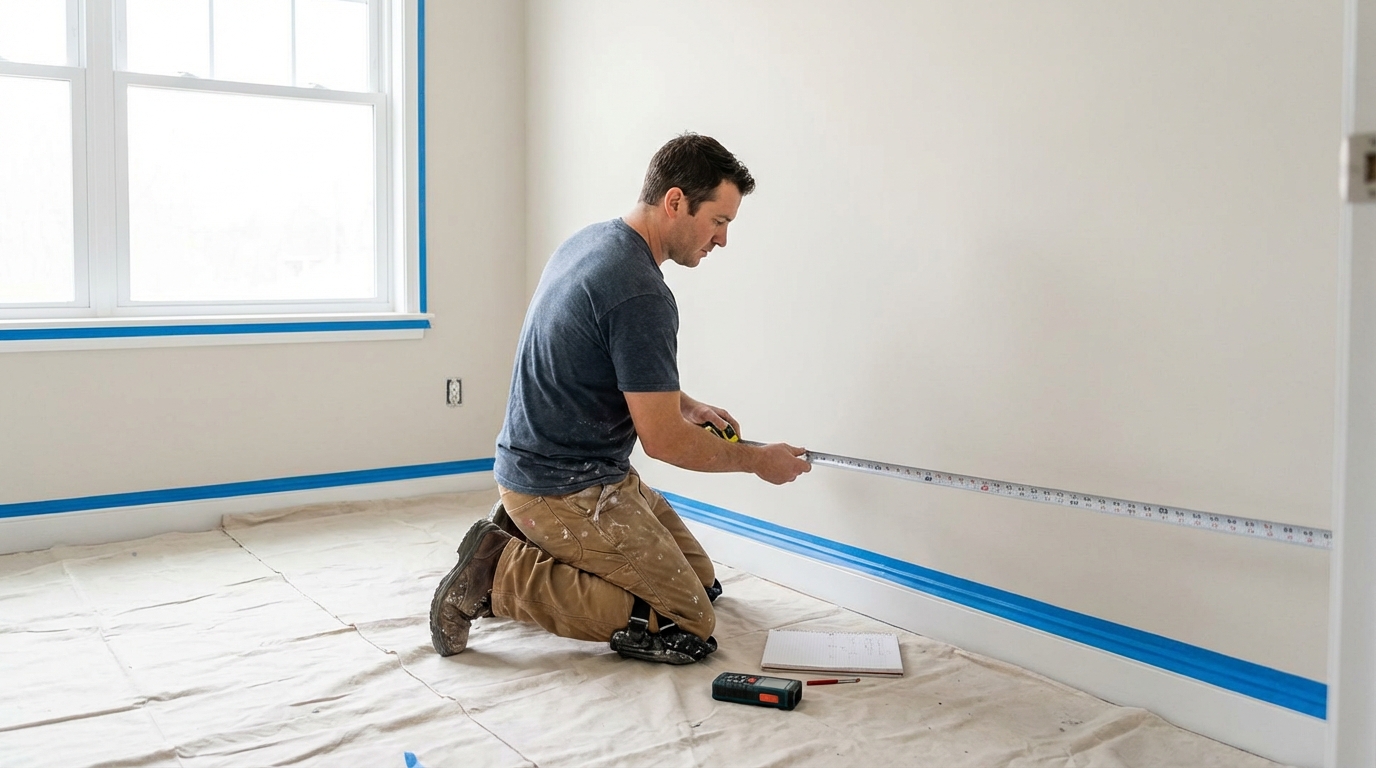
Calculating square footage
Wall square footage
Measure each wall: length x height. Add them up.
Example: 12 x 14 room with 9-foot ceilings
- Wall 1: 12 x 9 = 108 sq ft
- Wall 2: 14 x 9 = 126 sq ft
- Wall 3: 12 x 9 = 108 sq ft
- Wall 4: 14 x 9 = 126 sq ft
- Total: 468 sq ft
Subtract openings (optional)
Some painters subtract windows and doors, some don't. I don't subtract openings under 50 sq ft because the cut-in time around them often equals or exceeds the time saved.
Ceiling square footage
Simply length x width of the room.
Same room: 12 x 14 = 168 sq ft
Total paintable area
Walls (468) + Ceiling (168) = 636 sq ft
The pricing formula
Price = (Square footage x Rate) + Prep + Materials + Profit margin
Step 1: Base labor
636 sq ft x $2.50 (repaint, good condition) = $1,590
Step 2: Prep work add-ons
- Light cleaning / deglossing: $0.25 - $0.50 / sq ft
- Hole patching (minor): $5 - $15 per patch
- Hole patching (major): $25 - $75 per patch
- Wallpaper removal: $1.00 - $3.00 / sq ft
- Lead paint testing/protocol: $200 - $500 flat
Step 3: Materials
Paint costs:
- Budget paint: $25 - $40 / gallon
- Mid-range: $45 - $60 / gallon
- Premium: $65 - $90 / gallon
Coverage: 350-400 sq ft per gallon, first coat. Second coat covers more.
For our example room:
- 636 sq ft / 350 = 1.8 gallons first coat
- 636 sq ft / 400 = 1.6 gallons second coat
- Total: ~3.5 gallons, round to 4
- At $55/gallon mid-range: $220 materials
Step 4: Profit margin
Add 15-25% for overhead and profit.
Example calculation
| Line Item | Amount |
|---|---|
| Base labor (636 sq ft x $2.50) | $1,590 |
| Prep (light, 636 x $0.30) | $191 |
| Materials (4 gal x $55) | $220 |
| Subtotal | $2,001 |
| Profit margin (20%) | $400 |
| Total Quote | $2,401 |
Factors that increase price
High ceilings
- 9-10 ft: Standard pricing
- 10-12 ft: Add 15-25%
- 12-15 ft: Add 30-50%
- 15+ ft (requires lift): Add 50-100%
Difficult colors
- Dark to light: Add 25-50% (extra coats needed)
- Bright/saturated colors: Add 15-25% (coverage issues)
- Specialty finishes: Add 30-50%
Condition issues
- Heavy texture: Add 15-25%
- Smoke damage: Add 25-50%
- Water stains: Add per stain ($25-75)
- Mold remediation needed: Refer out or add significant premium
Access challenges
- Furniture moving required: Add $100-300 or require client to clear
- Stairs/scaffolding needed: Add 20-40%
- Occupied home (working around residents): Add 10-20%
What to include in your quote
Always specify:
Included:
- Number of coats
- Specific areas (walls, ceiling, trim)
- Paint grade and who provides
- Basic prep (what level)
- Timeline
Not included:
- Furniture moving (or specify)
- Wall repairs beyond minor patching
- Wallpaper removal
- Lead paint protocols
- Color changes during project
Payment terms
- Deposit: 25-50% to start
- Progress payment: (for larger jobs)
- Final: On completion and walkthrough
Common pricing mistakes
Underpricing prep
New painters consistently underestimate prep time. A room that needs wallpaper removed, holes patched, and walls sanded can take longer to prep than to paint.
Forgetting overhead
Your rate must cover:
- Vehicle costs
- Insurance
- Tools and equipment
- Marketing
- Unbillable time (estimates, travel, admin)
Pricing based on competition
Knowing competitor rates is useful, but pricing purely to undercut them is a race to bankruptcy. Price based on your costs plus profit.
Not adjusting for difficulty
A simple box room and a room with 14 corners, 6 windows, and cathedral ceilings aren't the same job. Price accordingly.
When to walk away
Some jobs aren't worth taking:
- Client wants champagne results on a beer budget
- Scope keeps expanding during negotiation
- Client disputes every line item
- Timeline is unrealistic
- Red flags about payment reliability
A bad job at the wrong price costs you money and reputation. Better to be selective.
Getting paid
Contracts matter
Even for small jobs, get it in writing:
- Scope of work
- Price
- Payment schedule
- Change order process
- Timeline
Progress payments
For jobs over $2,000:
- 30-50% deposit
- Progress payment at 50% completion
- Final on walkthrough
Change orders
When clients add scope mid-project:
- Stop and document the change
- Provide written add-on pricing
- Get approval before proceeding
Know your numbers, own your price
Know your numbers. Calculate square footage accurately, account for all prep work, include materials at actual cost, and add your margin.
Most importantly: don't apologize for your pricing. If you've calculated it correctly, it's fair. Clients who can't afford professional work aren't your clients.
Confident pricing wins more bids than desperate pricing. The clients worth having already know that good work costs money.