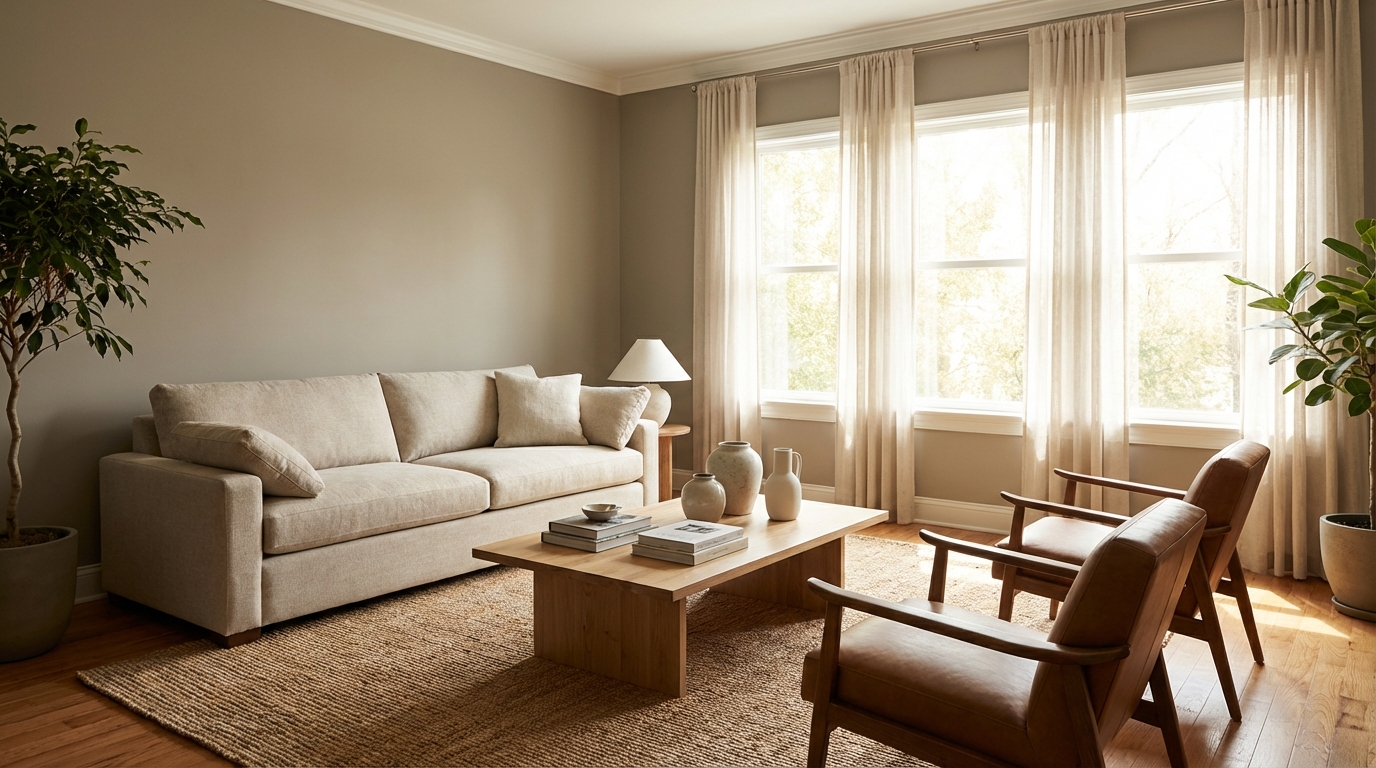
Warm neutral walls sell homes faster than any other color. That's what the data consistently shows. But the specific shade matters more than most sellers realize—and the "best" color has shifted in the last two years.
I've helped a few friends stage their homes for sale, and every time the first question is "should I repaint?" The answer is almost always yes—if you're strategic about it. A $200-400 investment in paint can return thousands at closing. But paint the wrong color and you're either wasting money or actively hurting your listing.
Here's what the real estate data actually says, room by room.
What the Data Shows
Real estate platforms like Zillow, Redfin, and Realtor.com have all published analyses on how paint color affects sale price and time on market. The findings line up:
Warm neutral walls correlate with higher sale prices. Homes with warm-toned walls (greige, warm white, soft taupe) sell for 1-3% more than the average.
Bold colors are polarizing. A deep navy dining room might appeal to 30% of buyers and turn off 70%. For resale, you want to appeal to the maximum number of people.
Cool grays are fading. A few years ago, Repose Gray was staging gold. Now warm tones are outperforming cool tones in sale data.
All-white everything doesn't perform as well as you'd think. Stark white reads as "unlived in" or "institutional." Warm whites outperform pure whites.
The important caveat: correlation isn't causation. Homes with updated paint often have other updates too (new fixtures, cleaned landscaping). But every real estate agent I've talked to says the same thing—fresh, well-chosen paint is the single highest-ROI improvement you can make before listing.
The Best Whole-House Colors for Resale
These are the "can't go wrong" colors for staging. They appeal to the broadest range of buyers:
Tier 1: The Safest Bets
Accessible Beige SW 7036 (Sherwin-Williams) — LRV: 58 The warm neutral that works with everything. It doesn't look beige in a dated way—it reads as modern, warm, and inviting. This is probably the single most-used staging color in the country right now.
Pale Oak OC-20 (Benjamin Moore) — LRV: 70 Lighter than Accessible Beige but with the same warmth. Perfect for homes with less natural light. Buyers walk in and the room feels spacious and welcoming.
Agreeable Gray SW 7029 (Sherwin-Williams) — LRV: 60 Still the most popular greige in America. It's starting to feel slightly dated to designers, but for resale it still works because buyers recognize it (even subconsciously) as "modern and updated."
Tier 2: Slightly Bolder (Still Safe)
Universal Khaki SW 6150 (Sherwin-Williams) — LRV: 37 The 2026 COTY. Using it signals "this home is updated to current trends." Slightly deeper than typical staging colors, but warm and universally appealing. Best in living rooms and bedrooms.
Edgecomb Gray HC-173 (Benjamin Moore) — LRV: 63 A greige that reads as elegant without trying too hard. Works well in higher-end homes where you want the paint to say "I'm tasteful" without saying anything too loudly.
Balanced Beige SW 7037 (Sherwin-Williams) — LRV: 46 A bit deeper than Accessible Beige. Good for dining rooms and dens where you want warmth without crossing into "bold" territory.
Room-by-Room Staging Colors
Living Room
Best color: Accessible Beige or Pale Oak (whole-room coverage)
The living room needs to feel spacious, bright, and warm. Avoid anything dark—even if dark living rooms are trending in magazines, buyers want to see potential. Light, warm walls let them imagine their own furniture and art.
If your living room has good light, Accessible Beige. If it's on the darker side, go lighter with Pale Oak.
Kitchen
Best wall color: Simply White OC-117 or Alabaster SW 7008
Kitchens should feel clean and bright. Warm whites are the move. Don't try to be creative with kitchen wall color for resale—buyers want to see the countertops, cabinets, and backsplash. The walls should be a neutral backdrop.
Best cabinet color (if repainting): White. Still. Zillow data consistently shows white kitchens sell for more. If you want personality, do navy or sage lower cabinets with white uppers—but only if the cabinets are in good enough condition to justify the work.
Bedroom
Best color: Pale Oak or Accessible Beige (master). Soft blue or sage green (secondary bedrooms).
Here's an interesting data point: secondary bedrooms painted in soft blue or muted green sell slightly better than all-neutral bedrooms. The theory is that buyers mentally assign rooms—"this could be the kid's room" or "this is the guest room"—and a subtle color helps with that visualization.
Best accent colors for secondary bedrooms:
- Sea Salt SW 6204 (LRV: 63) — easy-to-like blue-green
- Palladian Blue HC-144 (LRV: 61) — calm, grown-up blue
- Saybrook Sage HC-114 (LRV: 45) — warm, earthy green
Bathroom
Best color: White or very light warm white
Bathrooms should feel clean. Period. Light colors make small bathrooms feel bigger and cleaner bathrooms feel even cleaner. If your bathroom has good natural light, you can try a very light blue-gray. But white is the safe bet.
The data quirk: Zillow's analysis found that bathrooms painted in certain shades of light blue or periwinkle actually sold for MORE than white bathrooms. The theory: a subtle blue signals "spa" to buyers.
- Quiet Moments 1563 (Benjamin Moore) — LRV: 60. A barely-there blue-gray. Spa vibes without being "colorful."
Dining Room
Best color: This is the one room where you can go slightly bolder.
Real estate data shows that dining rooms with deeper, warm colors sell slightly better than all-neutral dining rooms. Buyers read a colored dining room as "intentional" and "designed" rather than "basic."
Safe bold options:
- Hale Navy HC-154 — LRV: 6. Navy dining rooms sell well.
- Evergreen Fog SW 9130 — LRV: 30. Current and polished.
- Smokey Taupe 983 — LRV: 25. Warm and intimate without being dark.
Don't go too bold though. Bright red, intense teal, or very dark black dining rooms can scare buyers. Keep it in the "moody but elegant" range.
Front Door
Best color: A dark, saturated tone that pops against your exterior.
This is curb appeal 101. The front door is the first impression. Data shows that homes with black, navy, or dark charcoal front doors sell for more than those with basic white or unstained wood doors.
- Wrought Iron 2124-10 (Benjamin Moore) — near-black with warmth
- Hale Navy HC-154 (Benjamin Moore) — always works
- Iron Ore SW 7069 (Sherwin-Williams) — warm near-black
The 5-Color Whole-House Staging Palette
If I had to paint a home for sale tomorrow with exactly five colors, here's what I'd use:
| Room | Color | Why |
|---|---|---|
| Living room, hallways, master bedroom | Accessible Beige SW 7036 | Warm, spacious, universal |
| Kitchen walls | Simply White OC-117 | Clean, bright, highlights features |
| Secondary bedrooms | Sea Salt SW 6204 | Subtle personality, universally liked |
| Bathrooms | Quiet Moments 1563 | Light, spa-like, clean |
| Dining room | Edgecomb Gray HC-173 (or Hale Navy for drama) | Sophisticated, intentional |
All trim and doors: Chantilly Lace OC-65 in semi-gloss. It's crisp white trim that works with every wall color above.
Total cost for an average-sized home: ~$300-500 in paint. Return: potentially thousands.
Colors to Absolutely Avoid When Selling
Bright or primary colors on walls. Red, orange, bright yellow, lime green. They turn off more buyers than they attract.
Personalized or quirky colors. That purple bedroom you love? The teal kitchen accent wall? Great for living in, terrible for selling. Buyers see "I'll have to repaint" and mentally deduct cost.
Dated colors. Mauve, dusty rose, hunter green (the '90s version), sponge-painted anything. If the paint looks like it belongs in a specific decade, it ages the home.
Dark colors in small rooms. A dark bathroom or small bedroom signals "this room is tiny." Light colors make these spaces feel bigger, which is exactly what buyers want.
Mismatched rooms. Different colors in every room with no flow creates visual chaos. A buyer walking through should feel a cohesive experience, not a different theme in each room.
The Timing Question
When to repaint before listing:
- Walls are scuffed, marked, or faded
- Current colors are bold, dated, or personalized
- You have different colors in every room with no cohesion
- The paint is visibly old or peeling
When NOT to repaint:
- Walls are already in a modern neutral and in good condition
- You have fresh, professional-quality paint job from the last 2-3 years
- Your colors are already in the warm neutral family
How far in advance: 2-4 weeks before listing photos. Fresh paint smells go away in a week. The clean, updated look lasts through the entire listing period.
The Digital Staging Angle
Here's a tip for real estate agents and sellers: use Muro to preview staging colors before buying paint. Take photos of each room and test the palette digitally. It takes 20 minutes and prevents the "we painted the master bedroom and it looks wrong" situation that costs time and money.
Some agents I know also use visualization screenshots in their listing consultations: "Here's your living room now, and here's what it would look like in Accessible Beige." It makes the ROI argument tangible.
The Bottom Line
Painting for resale isn't about expressing yourself. It's about creating a warm, neutral canvas that lets buyers imagine themselves living there.
Go warm. Go neutral. Go fresh. The 5-color palette above will work for 90% of homes. The investment is small. The return—in both sale price and speed—is real.
And please, whatever you do, repaint that accent wall before listing photos. Your real estate agent will thank you.