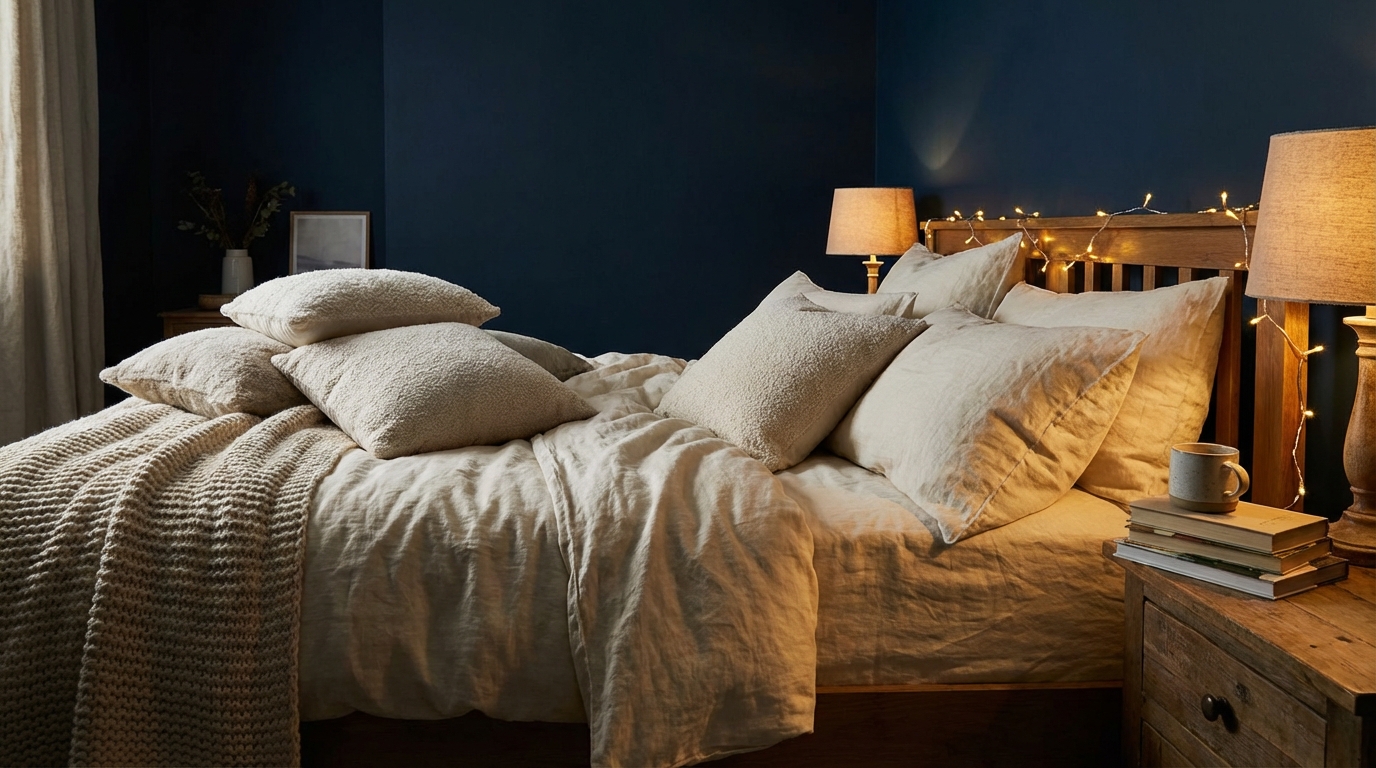
Moody paint colors, deep greens, dark navies, charcoal browns, dark plums, make rooms feel cozier, not smaller. That's the counterintuitive truth that keeps surprising people. Most folks assume dark paint will shrink a room. In reality, dark colors blur the boundaries of a space, making walls feel like they recede rather than close in.
I know because I was terrified the first time I went dark. Painted my home office in Hunt Club (a forest green with an LRV of 4). For the first three days, I kept second-guessing it. "This is too dark." "Did I make a mistake?" "My spouse is going to kill me."
By day five, I loved it. By day ten, it was my favorite room in the house. By month three, I was looking at other rooms thinking "what if I went dark in here too?"
That's the moody paint trajectory: fear, doubt, love. Almost every person I've talked to who went dark had the same experience.
But there's a right way and a wrong way to do it. And the wrong way leads to actual regret. So let me walk you through this.
Why people are going moody in 2026
This isn't random. There's a cultural shift happening:
Cocooning. After years of open, bright, "Instagram-ready" interiors, people want rooms that feel enclosed and protective. A room that wraps around you. Dark colors do that naturally.
The anti-minimalism backlash. All-white everything had its moment. People are craving personality, warmth, and—yes—drama. A dark room has character in a way that a white room never will.
Better lighting technology. LED strips, warm dimmable bulbs, smart lighting—we have better tools than ever to make dark rooms functional. Twenty years ago, going dark meant accepting a dim room. Now you can dial in exactly the lighting you want.
The 2026 trend cycle. Benjamin Moore's Silhouette, Graham & Brown's Divine Damson, Dunn-Edwards' Midnight Garden—three of this year's Colors of the Year are dark, moody tones. The industry is formally endorsing what designers have been doing quietly for years.
The "will it make my room feel smaller?" myth
Let's address this directly because it's the #1 fear.
Light colors make walls feel like they're pushing out. Dark colors make walls feel like they're disappearing. Counter-intuitive, right? But think about it: in a dark room, you can't clearly see where the wall ends. The edges dissolve. Your brain processes this as "undefined space" rather than "closed-in space."
When dark DOES make a room feel smaller:
- When the ceiling is white and the walls are dark (creates a box-lid effect)
- When the room has bad lighting (you need to see something)
- When the floor is also very dark (no contrast = cave)
When dark makes a room feel cozy, not small:
- When the ceiling is also dark (or at least warm)
- When lighting is warm and layered
- When the floor provides contrast (light wood, light rug)
- When there's at least one light element—white bedding, cream curtains, a light-colored piece of furniture
Picking your first moody color
If you've never lived with dark walls, start with one of these four categories. They're the most forgiving:
Deep navy (the gateway drug)
Navy is dark enough to feel moody but familiar enough that it doesn't panic you. People associate navy with sophistication—preppy blazers, elegant dining rooms. It's culturally coded as "classy," which makes the jump less scary.
- Hale Navy HC-154 (Benjamin Moore) — LRV: 6. The single most popular dark paint color for a reason. Rich enough to be dramatic, warm enough to be livable.
- In The Navy SW 9178 (Sherwin-Williams) — LRV: 4. Deeper and more saturated.
Forest green (the nature-lover's pick)
Green is calming. Even deep, dark green reads as "nature" to your brain, not "darkness." It's the moody color that people feel most comfortable with long-term.
- Hunt Club SW 6468 (Sherwin-Williams) — LRV: 4
- Backwoods 469 (Benjamin Moore) — LRV: 4
Charcoal brown (the warm option)
If you want moody without coolness, brown-based darks are your answer. They have a warmth that navy and green sometimes lack.
- Silhouette AF-655 (Benjamin Moore) — LRV: ~8
- Urbane Bronze SW 7048 (Sherwin-Williams) — LRV: 8
Deep plum (the bold choice)
Plum is the trendiest of the bunch right now. It's moody with a romantic quality—think Victorian parlors and wine bars.
- Chambourd AF-645 (Benjamin Moore) — LRV: 5
- Plummy (Farrow & Ball) — LRV: ~5
The room to start with
Powder room. Every time. Here's why:
- It's small, so you need less paint ($20-30 total)
- You don't spend hours in it, so even if you're unsure, it's not stressful
- Guests will see it and give you reactions (usually very positive)
- It's a 3-hour repaint if you hate it
- Dark colors in small spaces with a mirror and decent lighting look INCREDIBLE
Your second room: bedroom or dining room. Both benefit from the cocooning effect. Bedrooms get cozier. Dining rooms get more intimate.
Your living room should probably not be your first dark room—you spend too much time there to risk an "I'm not sure about this" feeling.
The non-negotiable: lighting
I've said this in other articles and I'll say it again because it's the difference between success and failure: dark walls without good lighting = miserable cave.
Here's your lighting checklist for a moody room:
Minimum requirements:
- Warm LED bulbs (2700K color temperature) in ALL fixtures
- At least 3 light sources (not just one overhead)
- One light source at eye level or below (table lamp, floor lamp)
For best results, add:
- LED strip lights above shelves or behind furniture (warm white)
- A dimmer switch on the overhead light
- At least one fixture with a warm metallic shade (brass, copper)
- Candles for evening use (not a joke—they transform dark rooms)
The biggest mistake: Keeping your existing cool-white overhead fluorescent fixture and painting the walls dark. That combo looks terrible. Always. The cool light turns dark paint colors grayish and lifeless. Swap to warm LEDs first. It costs $10 in bulbs and makes a huge difference.
Prep steps before you paint
1. Test the color (for real)
With dark colors, the gap between "chip" and "wall" is bigger than with light colors. A 2-inch chip of Hale Navy looks like a nice dark blue. Four walls of it feel completely different.
Do this: Buy a sample pot. Paint a 2x2 foot swatch on two different walls—one that gets direct light and one in shadow. Live with it for 48 hours minimum. Check it in morning light, evening light, and with just lamps on.
Or start digitally—preview the color in your room with Muro. It won't capture the full immersive feeling of being surrounded by the color, but it'll tell you if the shade is in the right ballpark.
2. Plan your ceiling
You have three options:
Option A: Paint the ceiling the same color as walls. This is the full color-drench approach. Most dramatic, most immersive, and it actually makes the room feel BIGGER because you eliminate the ceiling-wall boundary. My recommendation for rooms under 10 feet tall.
Option B: Paint the ceiling a warm off-white. White Dove OC-17 or Alabaster SW 7008. This is the compromise—keeps things from getting too intense while avoiding stark white contrast.
Option C: Keep the ceiling standard white. This works in rooms with high ceilings (10+ feet). In standard 8-foot rooms, a bright white ceiling against dark walls creates a lid-on-a-box feeling that I don't love.
3. Choose your finish
Matte for maximum moodiness. Dark colors in matte absorb light evenly and look velvety. This is the finish professional designers use for dark statement rooms.
Eggshell for practicality. Slightly easier to clean, still looks great. Better for rooms with kids or pets.
Avoid satin or semi-gloss on dark walls. The sheen creates uneven light reflection and hot spots that break the mood.
4. Prime if needed
If you're going dark over a very light wall, primer helps. Not strictly necessary with modern high-quality paint (two coats will cover), but tinted primer saves you from needing a third coat. Ask the paint store to tint your primer toward the final color.
The painting process
Dark paint is slightly less forgiving than light paint. A few tips:
Use quality paint. Cheap dark paint looks cheap. You'll see brush strokes, roller marks, and uneven coverage. Benjamin Moore, Sherwin-Williams, Behr Marquee—these have the pigment density to cover evenly.
Apply two solid coats. Don't try to cover in one thick coat. Two even coats dry better and look smoother. Let the first coat dry completely before applying the second.
Roll in one direction. Random roller patterns show more in dark paint. Roll each section from ceiling to floor in one direction for the smoothest finish.
Cut in carefully—or don't. If you're doing the whole room in one color (drenching), cutting in barely matters. If you have white trim, though, take your time. Dark paint on white trim is a visible mistake that's annoying to fix.
What about resale?
The honest answer: dark walls can be polarizing for buyers. Some will love the character. Others will mentally add "repaint everything" to their renovation budget.
If you're selling within a year: Maybe stick with a dark accent wall or keep the moody colors to one room. Powder rooms and dining rooms are generally buyer-safe because people expect them to have personality.
If you're staying for 3+ years: Paint what you love. Repainting before selling is a small cost compared to years of living in a space that doesn't feel like yours.
The bottom line
Going dark is scarier in theory than in practice. Almost everyone I know who took the leap ended up loving it. Here's what matters:
- Start with one room (powder room or bedroom)
- Pick a color with warm undertones
- Get your lighting right BEFORE you judge the color
- Paint the ceiling too (or at least use a warm off-white)
- Test first—sample pot or digital preview with Muro
Moody colors are a different way of experiencing your home. Cozier and more personal. And once you get used to it, bright white rooms start feeling a little empty.