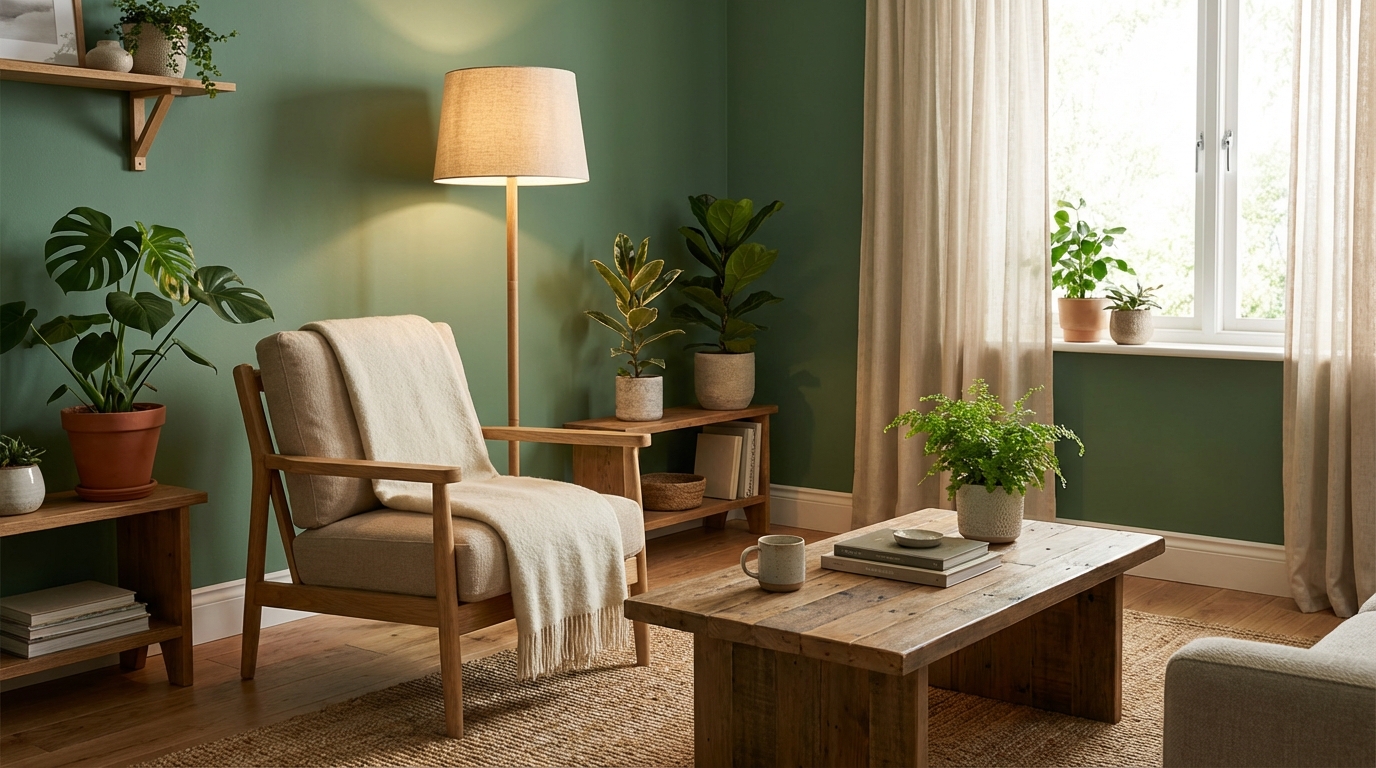
Green is the most-picked color family of 2026. Behr chose smoky jade. Valspar went warm eucalyptus. PPG picked yellow-green. Dunn-Edwards selected deep earthy green. Four of the twelve 2026 Colors of the Year are some shade of green, and designers are putting it everywhere—bedrooms, kitchens, living rooms, exteriors.
But here's the problem: "green" covers an absolutely enormous range. Sage green and forest green are about as different as beige and chocolate. Pick the wrong green and your serene bedroom becomes a hospital corridor. Or your sophisticated library starts looking like a golf course.
I've painted three different rooms green in the past two years. Got it right twice. Got it very wrong once (an olive green in my guest bathroom that made everyone look slightly ill under the vanity lights). So yeah—the shade matters.
Let me walk you through the full spectrum.
The green spectrum: a visual map
Think of green paint as falling on two axes:
Light to Dark (LRV high to low) Cool to Warm (blue-based to yellow-based)
Where a green sits on these two axes determines everything about how it feels in a room.
| Green Type | Undertone | LRV Range | Feeling |
|---|---|---|---|
| Sage | Gray-green, slightly cool | 35-55 | Soft, calming, safe |
| Eucalyptus | Warm green-gray | 25-40 | Nature-inspired, grounding |
| Jade/Teal | Blue-green | 8-25 | Bold, deep, dramatic |
| Forest | True deep green | 3-8 | Sophisticated, moody |
| Olive | Yellow-green | 20-40 | Earthy, organic, tricky |
| Mint | Cool green, high LRV | 55-75 | Fresh, light, retro |
| Hunter | Dark blue-green | 3-6 | Classic, library, formal |
Sage green: the safe starting point
Sage has been the gateway green for the last three years. It's approachable, it's pretty, it works with white trim, and it doesn't scare anyone at the paint store. There's a reason every other kitchen on Pinterest is sage.
The best sages:
- Softened Green SW 6177 (Sherwin-Williams) — LRV: 57. A true, balanced sage. Not too blue, not too yellow. The "I want green but I'm nervous" color.
- Saybrook Sage HC-114 (Benjamin Moore) — LRV: 45. Slightly deeper and moodier than Softened Green. More character.
- October Mist 1495 (Benjamin Moore) — LRV: 48. Was the 2022 Color of the Year. A soft sage with gray undertones. Still gorgeous.
Where sage works: Kitchens (especially with white or wood cabinets), living rooms, bedrooms, bathrooms. Honestly, sage works almost everywhere. That's its superpower and its limitation—it can feel predictable.
Where sage fails: Rooms with very little natural light. Low light brings out the gray in sage and it can start looking flat and lifeless. If your room is dark, go deeper (forest) or lighter (mint).
Is sage over? Not yet. But it's no longer the fresh, exciting choice it was in 2022. In 2026, sage is more "reliable classic" than "hot trend." Which, depending on your personality, might be exactly what you want.
Eucalyptus green: the 2026 sweet spot
Valspar named Warm Eucalyptus their 2026 Color of the Year, and I think it's the most livable green on the spectrum right now.
Eucalyptus green sits between sage and forest. It's deeper than sage but not as dark or dramatic as forest. The "warm" part means it leans slightly yellow-green rather than blue-green, which makes it feel more natural and organic.
The best eucalyptus greens:
- Warm Eucalyptus (Valspar) — LRV: ~28. The COTY pick. Warm, grounded, nature-inspired.
- Evergreen Fog SW 9130 (Sherwin-Williams) — LRV: 30. The 2022 COTY that people are STILL obsessed with. Technically more of a green-gray but lives in the same family.
- Cushing Green HC-125 (Benjamin Moore) — LRV: 24. More saturated than the others. Feels more intentionally "green."
Where eucalyptus works: Living rooms, bedrooms, home offices. It's the green that works for hours-long exposure without fatiguing your eyes.
How it differs from sage: Eucalyptus feels more grown-up. Sage is pretty. Eucalyptus is sophisticated. If sage is a sundress, eucalyptus is a blazer.
Jade & smoky teal: the bold statement
This is where green meets blue, and where Behr's 2026 Color of the Year (Hidden Gem) lives. Jade and teal-adjacent greens are the "I want a room with personality" choice.
The best jade/teal greens:
- Hidden Gem N430-6A (Behr) — LRV: 12. Smoky, complex, shifts between blue and green depending on light. My personal favorite green of 2026.
- Aegean Teal 2136-40 (Benjamin Moore) — LRV: 24. More approachable than Hidden Gem. Reads more blue-green in daylight.
- Riverway SW 6222 (Sherwin-Williams) — LRV: 11. Deep and dramatic. A commitment color.
Where jade works: Bedrooms (creates a calm, enveloping feel), home offices (focus-enhancing), dining rooms (dramatic by candlelight), powder rooms (instant personality).
Where jade fails: Small rooms with no natural light. At LRV 12, Hidden Gem will eat all your light. You need at least one decent window or really good artificial lighting.
The psychology: Blue-green tones are consistently rated as the most calming color family in studies. If you're picking a bedroom color based on relaxation, this is the science-backed answer.
Forest & hunter green: the library look
Deep, dark green. This is the green of British libraries, old money studies, and every "dark academia" mood board on Pinterest. It's not for the faint of heart.
The best forest/hunter greens:
- Hunt Club SW 6468 (Sherwin-Williams) — LRV: 4. A true, deep forest green. The classic choice.
- Backwoods 469 (Benjamin Moore) — LRV: 4. Slightly more blue than Hunt Club. Feels more contemporary.
- Midnight Garden (Dunn-Edwards) — The 2026 COTY. Deep, earthy, almost black-green.
Where forest green works: Home offices, libraries, dining rooms, bedrooms (if you're ok with a moody sleep space). Powder rooms are a great starter space for forest green.
Where forest green fails: Kitchens (too dark for a functional space), kids' rooms (too somber), rooms with no windows. Also fails in open-concept living spaces—it's too strong to flow into other rooms.
The light situation: At LRV 3-6, these colors need help. Warm LED strips, table lamps, candles. Layer your lighting or the room becomes a cave. I added warm LED strips above my office bookshelves when I painted it Hunt Club, and it made all the difference.
Olive green: the tricky one
I have to be honest—olive green is hard. It's the green that goes wrong most often.
Olive sits at the yellow end of the green spectrum. When it works (warm light, earth-toned furniture, the right sheen), it's gorgeous—organic, warm, interesting. When it doesn't work (cool light, wrong skin-tone interaction, glossy finish), it looks like baby food. Or worse, it makes skin tones look greenish.
If you want to try olive:
- Secret Garden SW 6181 (Sherwin-Williams) — LRV: 15. A safer olive that leans more green than yellow.
- Bonsai Tint 2152-30 (Benjamin Moore) — LRV: 14. Warmer, more traditional olive.
My advice: Test olive more extensively than any other green. What looks earthy and sophisticated in your Instagram saves might look like pea soup on your specific walls with your specific lighting. The undertones are just more volatile than other greens.
Mint green: the retro play
Mint is the lightest, coolest green. It's having a minor comeback thanks to the broader retro/Art Deco revival, but it's a niche choice.
The thing about mint: It can read as juvenile or dated if you're not careful. To make it work in 2026, pair it with brass hardware and warm wood—not white and chrome, which pushes it into "ice cream parlor" territory.
- Palladian Blue HC-144 (Benjamin Moore) — LRV: 61. Technically a blue-green but lives in the mint family. The sophisticated version of mint.
- Waterfall 2050-50 (Benjamin Moore) — LRV: 57. Lighter, fresher. Works in bathrooms and sunrooms.
How to pick the right green for your room
By room light
| Light Condition | Best Greens | Avoid |
|---|---|---|
| Lots of south-facing light | Any green works. Go bold. | N/A |
| North-facing, cool light | Warm greens (eucalyptus, warm sage) | Cool greens (jade, mint)—they'll read even colder |
| Limited natural light | Lighter greens (sage, mint) OR go very dark (forest) with good lamps | Mid-range greens (they look flat in low light) |
| Artificial light only | Warm greens with warm LED bulbs | Any cool green + cool bulbs = institutional |
By room function
- Bedroom: Sage or eucalyptus for calm. Jade for drama. Forest if you want a cocoon.
- Kitchen: Sage. Always sage. It works with cabinets and doesn't fight with food colors.
- Living room: Eucalyptus or warm sage. Not too dark for extended time, not too light to feel boring.
- Home office: Jade or forest. Green reduces eye strain and aids concentration.
- Bathroom: Sage or jade. Both work with white fixtures and natural light.
- Dining room: Forest or hunter. Moody evening lighting makes these colors glow.
By existing furniture
- Warm wood tones (oak, walnut): Sage, eucalyptus, or forest. The warm tones work well together.
- Cool metals (chrome, stainless): Jade or teal greens. The cool-meets-cool creates a cohesive modern feel.
- Leather furniture: Forest green + brown leather is a design cliché for a reason. It works.
- Colorful textiles: Stick with sage or a muted eucalyptus. Don't compete.
Will green date quickly?
This is the question everyone asks. And honestly? Some greens will, some won't.
Sage is well into "classic" territory. It's the new beige. It'll feel timeless for at least another decade.
Eucalyptus and jade have maybe 3-5 years of trendiness left before they start to feel "2024-2026." But they're beautiful enough that even when they're "dated," they'll still look good.
Forest/hunter green is genuinely timeless. It's been used in high-end interiors for centuries. A forest green library or dining room never goes out of style.
Olive is the riskiest. It's been in and out multiple times. If you love it, go for it—but know it might feel "very 2025" in a few years.
The bottom line
Green is dominating 2026 because people want connection to nature, calm, and spaces that feel alive without being chaotic.
Pick your shade based on your light, your room, and your courage level. Sage if you want safe. Eucalyptus if you want sophisticated. Jade if you want bold. Forest if you want dramatic.
And please—test before you commit. Green varies wildly between the chip and the wall. What looks like sophisticated sage on a 2-inch sample can read as hospital green on four walls. Preview it in your actual space first with Muro, then sample your top picks.
The right green is out there. You just have to find your specific shade.